Quantum Fundamentals: NoTerm-2021
HW 7 : Due 3/3 Wed
- Spin One Interferometer Brief
S0 4112S
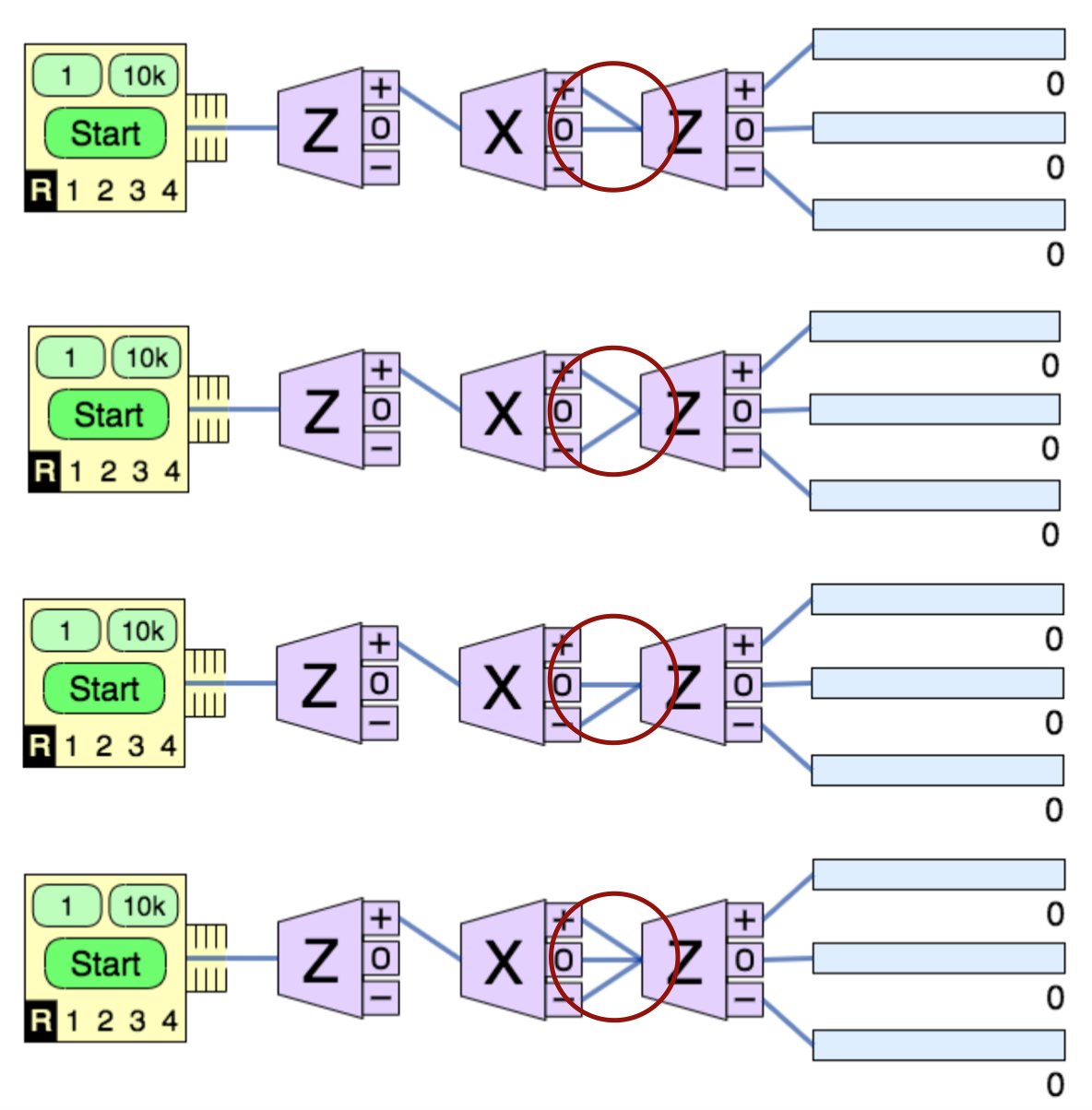
Consider a spin 1 interferometer which prepares the state as \(| 1\rangle\), then sends this state through an \(S_x\) apparatus and then an \(S_z\) apparatus. For the four possible cases where a pair of beams or all three beams from the \(S_x\) Stern-Gernach analyzer are used, calculate the probabilities that a particle entering the last Stern-Gerlach device will be measured to have each possible value of \(S_z\). Compare your theoretical calculations to results of the simulation. Make sure that you explicitly discuss your choice of projection operators.
Note: You do not need to do the first case, as we have done it in class.
- Completeness Relation Change of Basis
S0 4112S
Given the polar basis kets written as a superposition of Cartesian kets \begin{eqnarray*} \left|{\hat{s}}\right\rangle &=& \cos\phi \left|{\hat{x}}\right\rangle + \sin\phi \left|{\hat{y}}\right\rangle \\ \left|{\hat{\phi}}\right\rangle &=& -\sin\phi \left|{\hat{x}}\right\rangle + \cos\phi \left|{\hat{y}}\right\rangle \end{eqnarray*}
Find the following quantities: \[\left\langle {\hat{x}}\middle|{\hat{s}}\right\rangle ,\quad \left\langle {\hat{y}}\middle|{{\hat{s}}}\right\rangle ,\quad \left\langle {\hat{x}}\middle|{\hat{\phi}}\right\rangle ,\quad \left\langle {\hat{y}}\middle|{\hat{\phi}}\right\rangle \]
- Given a vector written in the polar basis \[\left|{\vec{v}}\right\rangle = a\left|{\hat{s}}\right\rangle + b\left|{\hat{\phi}}\right\rangle \] where \(a\) and \(b\) are known. Find coefficients \(c\) and \(d\) such that \[\left|{\vec{v}}\right\rangle = c\left|{\hat{x}}\right\rangle + d\left|{\hat{y}}\right\rangle \] Do this by using the completeness relation: \[\left|{\hat{x}}\right\rangle \left\langle {\hat{x}}\right| + \left|{\hat{y}}\right\rangle \left\langle {\hat{y}}\right| = 1\]
- Using a completeness relation, change the basis of the spin-1/2 state \[\left|{\Psi}\right\rangle = g\left|{+}\right\rangle + h\left|{-}\right\rangle \] into the \(S_y\) basis. In otherwords, find \(j\) and \(k\) such that \[\left|{\Psi}\right\rangle = j\left|{+}\right\rangle _y + k\left|{-}\right\rangle _y\]
- Phase 2
S0 4112S
Consider the three quantum states:
\[\left\vert \psi_1\right\rangle = \frac{4}{5}\left\vert +\right\rangle+ i\frac{3}{5} \left\vert -\right\rangle\]
\[\left\vert \psi_2\right\rangle = \frac{4}{5}\left\vert +\right\rangle- i\frac{3}{5} \left\vert -\right\rangle\]
\[\left\vert \psi_3\right\rangle = -\frac{4}{5}\left\vert +\right\rangle+ i\frac{3}{5} \left\vert -\right\rangle\]
- For each quantum state \(\left|{\psi_i}\right\rangle \) given above, calculate the probabilities of obtaining \(+\frac{\hbar}{2}\) and \(-\frac{\hbar}{2}\) when measuring the spin component along the \(x\)-, \(y\)-, and \(z\)-axes.
- Look For a Pattern (and Generalize): Use your results from \((a)\) to comment on the importance of the overall phase and of the relative phases of the quantum state vector.