Quantum Fundamentals: NoTerm-2021
HW 4 : Due 2/19 Fri
- Eigenvectors of the Rotation Matrix
S0 4109S
The orthogonal matrix
\[R_z(\theta)=
\begin{pmatrix}
\cos\theta&-\sin\theta&0\\ \sin\theta&\cos\theta&0\\ 0&0&1\\
\end{pmatrix}
\]
corresponds to a rotation around the \(z\)-axis by the angle \(\theta\).
- Find the eigenvalues of this matrix.
- Find the normalized eigenvectors of this matrix.
- Describe how the eigenvectors do or do not correspond to the vectors which are held constant or “only stretched” by this transformation.
- Eigenvectors of Pauli Matrices
S0 4109S
- Find the eigenvalues and normalized eigenvectors of the Pauli matrices \(\sigma_x\), \(\sigma_y\), and \(\sigma_z\) (see the Spins Reference Sheet posted on the course website).
- Statistical Analysis of the Spins Sim
S0 4109S
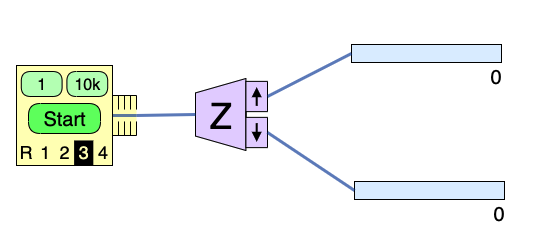
In the spins sim, the oven can be set to emit particles in a particular unknown prepared state (instead of in a random state).
- Set the oven to Unknown #3.
- Orient the analyzer in the \(z\)-direction.
- Perform 5 sets of 10,000 Stern-Gerlach experiments (10,000 particles are sent through a Stern-Gerlach Analyzer) and record the number of particles that end up in the top counter.
- For each set of experiments, calculate the probability that a single particle was measured to have \(S_z = +\hbar/2\).
Do all of the following calculations by hand (you can use a calculator to help with the arithmetic).
Plot a histogram of the probabilities you measured for each set. Use a bin size of 0.002 for the horizontal axis. (Choose appropriate values on the horizontal axis. You don't need to plot the full possible values 0-1. You may use a computer to make the histogram or you can sketch it by hand.)
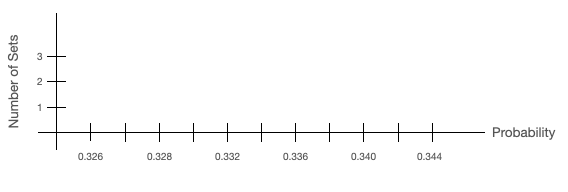
- What is your best estimate of the probability that, when you measure \(S_z\) of a particle in the Unknown #3 state, you will get a result of \(+\hbar/2\)? Mark this value on your histogram.
- Eigen Spin Challenge
S0 4109S
Consider the arbitrary Pauli matrix \(\sigma_n=\hat n\cdot\vec
\sigma\) where \(\hat n\) is the unit vector pointing in an arbitrary
direction.
- Find the eigenvalues and normalized eigenvectors for \(\sigma_n\). The answer is: \[ \begin{pmatrix} \cos\frac{\theta}{2}e^{-i\phi/2}\\{} \sin\frac{\theta}{2}e^{i\phi/2}\\ \end{pmatrix} \begin{pmatrix} -\sin\frac{\theta}{2}e^{-i\phi/2}\\{} \cos\frac{\theta}{2}e^{i\phi/2}\\ \end{pmatrix} \] It is not sufficient to show that this answer is correct by plugging into the eigenvalue equation. Rather, you should do all the steps of finding the eigenvalues and eigenvectors as if you don't know the answer. Hint: \(\sin\theta=\sqrt{1-\cos^2\theta}\).
- Show that the eigenvectors from part (a) above are orthogonal.
- Simplify your results from part (a) above by considering the three separate special cases: \(\hat n=\hat\imath\), \(\hat n=\hat\jmath\), \(\hat n=\hat k\). In this way, find the eigenvectors and eigenvalues of \(\sigma_x\), \(\sigma_y\), and \(\sigma_z\).