Energy and Entropy: Winter-2026 HW 4 (SOLUTION): Due Day 20 W7 D3
Heat Pump
S1 5488S
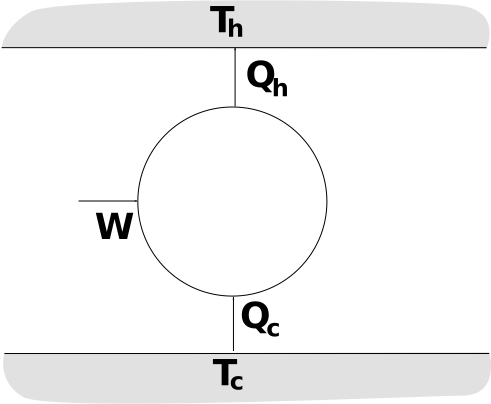
A heat pump is a refrigerator (or air conditioner) run backwards,
so that it cools the outside air (or ground) and warms your house.
We will call \(Q_h\) the amount of heat delivered to your home, and
\(W\) the amount of electrical energy used by the pump.
Define a coefficient of performance \(\gamma\) for a heat pump,
which (like the efficiency of a heat engine) is the ratio of
“what you get out” to “what you put in.”
We know this is a ratio of what we get out over what we put in. A heat pump heats an already hot area, thus the heat out, \(Q_h\), is what we get out. We have to pay with the work we put in, so we can define the coefficent of performance as:
\begin{align}
\gamma &\equiv \frac{Q_h}{W}
\end{align}
Use the second law of thermodynamics to find an equation for
the coefficient of performance of an ideal (reversible) heat pump,
when the temperature inside the house is \(T_h\) and the
temperature outside the house is \(T_c\). What is the
coefficent of performance in the limit as \(T_c \ll T_h\)?
An optimal heat pump will be a reversible heat pump, so the
change in entropy of the system plus surroundings will be zero.
\begin{align}
0 &= \Delta S_{hot} + \Delta S_{cold} \\
&= \frac{Q_h}{T_h} - \frac{Q_c}{T_c} \\
\frac{Q_c}{Q_h} &= \frac{T_c}{T_h}
\end{align}
Now we can use the first law to find that
\begin{align}
W + Q_c &= Q_h \\
W &= Q_h - Q_c \\
\gamma &\equiv \frac{Q_h}{W} \\
&= \frac{Q_h}{Q_h - Q_c} \\
&= \frac{1}{1 - \frac{Q_c}{Q_h}} \\
&= \frac{1}{1 - \frac{T_c}{T_h}}
\end{align}
This is a bit exciting, since it's greater than one! We get out of
a heat pump more than we put in! \(\ddot\smile\) In the limit of
low cold temperature, this becomes
\begin{align}
\eta &\approx 1 + \frac{T_c}{T_h}
\end{align}
so we don't gain a whole lot. It's always greater than one, since
we always can dump the work energy into the hot reservoir (our
house).
Discuss your result in the limit where the indoor and outdoor
temperatures are close, i.e. \(T_h - T_c \ll T_h\). Does it make
sense?
\begin{align}
\gamma &= \frac{T_h}{\Delta T}
\end{align}
When the two temperatures are very close, the efficiency
becomes very high, going to infinity when they are equal. This
makes sense. For one thing, if the outside temperature was higher
than the inside, we could just open the windows and heat our house
up with no work needed at all (infinite efficiency!). Or to put
it another way, so long as the inside is only slightly warmer than
the outside, we aren't gaining much by heating the house.
What is the ideal coefficient of performance of a heat pump
when the indoor temperature is \(70^\circ\)F and the outdoor
temperature is \(50^\circ\)F? How does it change when the outdoor
temperature drops to \(30^\circ\)F?
\begin{align}
\gamma &= \frac{1}{1 - \frac{T_c}{T_h}} \\
&= \frac{1}{1 -
\frac{273K + (50^\circ F - 32)\frac{5K}{9^\circ F}}{273K + (70^\circ F - 32)\frac{5K}{9^\circ F}}} \\
&= \frac{1}{1 - \frac{283K}{294K}} \\
&= 26.7
\end{align}
And when it is freezing outside...
\begin{align}
\gamma &= \frac{1}{1 - \frac{T_c}{T_h}} \\
&= \frac{1}{1 -
\frac{273K + (30^\circ F - 32)\frac{5K}{9^\circ F}}{273K + (70^\circ F - 32)\frac{5K}{9^\circ F}}} \\
&= \frac{1}{1 - \frac{272K}{294K}} \\
&= 13.4
\end{align}
So you can see that we lose a lot of efficiency when it
gets cold out!
Power Plant on a River
S1 5488S
At a power plant that produces 1 GW
(\(10^{9} \text{watts}\)) of electricity, the steam turbines take in steam at a
temperature of \(500^{o}C\), and the waste energy is expelled into the
environment at \(20^{o}C\).
What is the maximum possible efficiency of this plant?
Suppose you arrange the power plant to expel its waste energy
into a chilly mountain river at \(15^oC\). Roughly how much money can
you make in a year by installing your improved hardware, if you sell
the additional electricity for 10 cents per kilowatt-hour?
\begin{align}
\eta_\text{new} &= 1 -\frac{T_c}{T_H} \\
&= 1 - \frac{288 \text{ K}}{773 \text{ K}} \\
&= 62.743\%
\end{align}
This gives us an additional power of
\begin{align}
P_\text{new} &= 1\text{ GW} \frac{62.743\%}{62.096\%} \\
&= 1.01 \text{ GW} \\
P_\text{new} - P_\text{old} &= 10 \text{ MW}
\end{align}
A year has 8766 hours, so we produce an extra around \(9\times
10^8\) kW-hour, which is worth $10,000,000.
At what rate will the plant expel waste energy into this river?
Let's look at the work and heat in a given second.
We know the \(W\), which is 1 GJ, and want to solve for the heat dumped
in the cool sink, \(Q_C\).
\begin{align}
W &= Q_H-Q_C \\
W &= \eta \, Q_H \\
W &= \frac{W}{\eta}-Q_C \\
Q_C &= \left(1 - \frac1\eta \right)W
\\
&= \left(\frac1{0.62} - 1\right)10^9 \text{J} \\
&= 6.1\times 10^8 \text{ J}
\end{align}
So we're expelling energy into the river at \(6.1\times 10^8\) W. Unsurprisingly,
this is about the same as the power produced by the plant, since the efficiency
is not that far from 50%.
Assume the river's flow rate is 100 m\(^{3}/\)s. By how much will
the temperature of the river increase?
This flow rate means that in one second, 100 m\(^3\) of water
pass by, and we'll give that water \(6.1\times 10^8\) J.
\begin{align}
Q &= C_p\Delta T \\
&= 4.2 \frac{\text{J}}{\text{g K}} 100 \text{ m}^3
\left(\frac{100\text{ cm}}{1 \text{ m}}\right)^3 \left(\frac{1 \text{ g}}{1 \text{ m}^3}\right)\Delta T \\
\Delta T &= \frac{6.1\times 10^8 \text{J}}{4.2
\frac{\text{J}}{\text{g K}}
100m^3\left(\frac{100 \text{ cm}}{1 \text{ m}}\right)^3
\left(\frac{1 \text{ g}}{1 \text{ cm}^3}\right)} \\
&= 1.45 \text{ K}
\end{align}
That doesn't seem too bad... but then, a 1 GW plant isn't such a
very large plant, and you might wonder what would happen if there
are several of these on the same river. And I don't know, maybe fish
or algae would be significantly affected by even a temperature change
this small.
To avoid this “thermal pollution” of the river the plant could
instead be cooled by evaporation of river water. This is more
expensive, but it is environmentally preferable. At what rate must
the water evaporate? What fraction of the river must be evaporated?
We can look up the latent heat of vaporization of water
in Wikipedia, and find a value of 2260 J/g. Thus each second we
need to evaporate
\begin{align}
Q &= mL \\
m &= \frac{Q}{L} \\
&= \frac{6.1 \times 10^8 \text{ J}}{2260 \text{ J/g}} \\
&= 270 \text{ kg}
\end{align}
This is 270 kg of water, which means \(2.7\times 10^5\) cm\(^3\),
which corresponds to about a quarter of a cubic meter, which means
a quarter of a percent of the water in the river. That doesn't
sound so bad, perhaps, and it shouldn't affect the ecosystem so
much.
For perspective, the average flow rate of the Willamette is around
1000 m\(^3\)/s, so this problem involves a smallish stream. On the
other hand, a large river is more likely to have many industrial
plants along it (e.g. in every city that it passes through).
Bottle in a Bottle Part 2
S1 5488S
Consider the bottle-in-a-bottle problem in a previous problem set, summarized here.
A small bottle of
helium is placed inside a large bottle, which otherwise contains
vacuum. The inner bottle contains a slow leak, so that the helium
leaks into the outer bottle. The inner bottle contains one tenth
the volume of the outer bottle. The outer bottle is insulated.
The volume of the small bottle is 0.001 m\(^3\) and the volume of the big bottle is 0.01 m\(^3\). The initial state of the gas in the small bottle was \(p=106\) Pa and its temperature \(T=300\) K. Approximate the helium gas as an ideal gas of equations of state \(pV=Nk_BT\) and \(U=\frac32 Nk_BT\).
How many molecules of gas are initially in the small bottle? What is the final temperature of the gas after the pressures have equalized?
From the equation of state, one gets
\begin{equation*}
N=\frac{p V}{k_{B} T}=\frac{(106 Pa)(0.001m^3)}{(1.38*10^{-23}\frac{J}{K})(300K)}=2.56 \times \end{equation*}
The final temperature of the gas is 300 K. This free expansion does no work (since there is nothing moving to push against). Furthermore, since since this is a free expansion that does no work, and since outer bottle is insulated, no energy is transfered by heating. This means that the internal energy must not change, and thus the temperature does not change, because \(U=NkT\).
Compute the change of entropy \(\Delta S\) between the initial state (gas in the small bottle) and the final state (gas in both bottles, pressures equalized). Do not use the Sackur-Tetrode equation, use an alternative method.
The big bottle is thermally insulated from its surroundings, and there are no temperature differences inside the big bottle, therefore, \(\int \frac{{\mathit{\unicode{273}}} Q}{T} = 0\) for the leaky-bottle process. However, a free-expansion process, like this one, is not quasi-static. We can't trust \(\int \frac{{\mathit{\unicode{273}}} Q}{T}\) as a measure of entropy change. To figure out \(\Delta S\), we must think of a quasi-static process that goes from the inital state to the final state.
We can pick any quasi-static process that has the same initial and final state. The easiest choice for our calcuation is a slow isothermal expansion. For this alternative process, imagine that the small bottle does not leak. Instead, the small bottle gradually grows to the same size as the large bottle. Heat is allowed to flow from the outside world into the gas, so the gas stays at the same temperature throughout the expansion. We'll keep track of the heat entering the gas during this quasi-static process, and then compute \(\int \frac{{\mathit{\unicode{273}}} Q}{T}\).
\begin{equation*}
T dS=p dV
\end{equation*}
\begin{equation*}
dS=\frac{p}{T}dV=\frac{N k_B}{V} dV
\end{equation*}
Where we used the equation of state in the last step. Integrating we have:
\begin{align*}
\Delta S&=\int_{V_i}^{V_f} \frac{N k_{B}}{V} d V
\\
&=N k_{B} \ln \left(\frac{V_f}{V_i}\right)
\\
&= N k_B\ln(10)
\\
&\approx 8.34*10^{-4} \frac{J}{K}
\end{align*}
You could choose a more tricky path, such as an adiabatic expansion to the final volume followed by a constant-volume heating to the initial temperature. But that would just be a pain.
Discuss your results.
Gas leaking out of the pressurized small bottle to fill the large bottle is a natural, spontaneous, irreversible process. According to the second law of thermodynamics, such a process must be accompanied by an increase of entropy. However, the simple integration of \({\mathit{\unicode{273}}} Q/T\) cannot be applied directly to this process, because the process is not quasi-static.
It's very easy to forget to check for quasi-static processes, since we most often work with quasistatic processes in our homework!
Adiabatic Ideal Gas
S1 5488S
Consider the adiabatic expansion of a simple ideal gas (adiabatic means that no energy is transfered by heating). The internal energy is given by
\begin{align}
U &= C_v T
\end{align}
where you may take \(C_v\) to be a constant---although for a
polyatomic gas such as oxygen or nitrogen, it is
temperature-dependent. The ideal gas law
\begin{align}
pV &= Nk_BT
\end{align}
determines the relationship between \(p\), \(V\) and \(T\). You may take
the number of molecules \(N\) to be constant.
Use the first law to relate the inexact differential for work to the exact differential \(dT\) for an adiabatic process.
Since we're interested in an adiabatic compression, we know
that \(Q\) is zero. So
\begin{align}
dU &= {\mathit{\unicode{273}}} Q + {\mathit{\unicode{273}}} W \\
dU &= {\mathit{\unicode{273}}} W \quad\textit{since it's adiabatic} \\
C_vdT &= {\mathit{\unicode{273}}} W\quad\textit{from the formula for \(U\)} \\
{\mathit{\unicode{273}}} W &= C_vdT
\end{align}
Find the total differential \(dT\) where \(T\) is a function \(T(p,V)\).
This is just math using the ideal gas law...
\begin{align}
T &= \frac{pV}{Nk_B} \\
dT &= \frac{pdV + Vdp}{Nk_B}
\end{align}
In the previous two sections, we found two formulas involving
\(dT\). Use the additional definition of work \({\mathit{\unicode{273}}} W = -pdV\) to
solve for the relationship between \(p\), \(dp\), \(V\) and \(dV\) for an
adiabatic process.
Our three equations are
\begin{align}
{\mathit{\unicode{273}}} W &= C_vdT \\
dT &= \frac{pdV + Vdp}{Nk_B}\\
{\mathit{\unicode{273}}} W &= -pdV
\end{align}
We can use the first and second to find that
\begin{align}
{\mathit{\unicode{273}}} W &= \frac{C_v}{Nk_B} \left(pdV + Vdp\right)
\end{align}
which we can combine with the third to obtain
\begin{align}
pdV &= - \frac{C_v}{Nk_B} \left(pdV + Vdp\right) \\
pdV + \frac{C_v}{Nk_B}pdV &= - \frac{C_v}{Nk_B} Vdp \\
\left(\frac{C_v}{Nk_B}+1\right) pdV &= - \frac{C_v}{Nk_B} Vdp \\
\left(\frac{C_v}{Nk_B}+1\right) \frac{dV}{V} &= - \frac{C_v}{Nk_B} \frac{dp}{p} \\
\left(1+\frac{Nk_B}{C_v}\right) \frac{dV}{V} &= -\frac{dp}{p}
\end{align}
Integrate the above differential equation to find a
relationship between the initial and final pressure and volume for
an adiabatic process.
At this point, we can integrate both sides of the equation
\begin{align}
\int_{V_i}^{V_f} \left(1+\frac{Nk_B}{C_v}\right) \frac{dV}{V} &= -
\int_{p_i}^{p_f}\frac{dp}{p} \\
\left(1+\frac{Nk_B}{C_v}\right)\left(\ln V_f - \ln V_i\right) &=
\ln p_i - \ln p_f \\
\left(1+\frac{Nk_B}{C_v}\right)\ln\left(\frac{V_f}{V_i}\right)
&=
\ln\left(\frac{p_i}{p_f}\right) \\
\ln\left(\frac{V_f}{V_i}\right)^{1+\frac{Nk_B}{C_v}}
&=
\ln\left(\frac{p_i}{p_f}\right) \\
\left(\frac{V_f}{V_i}\right)^{1+\frac{Nk_B}{C_v}}
&=
\frac{p_i}{p_f} \\
p_f V_f^{1+\frac{Nk_B}{C_v}} &= p_i V_i^{1+\frac{Nk_B}{C_v}}
\end{align}
The quantity \(1+\frac{Nk_B}{C_v}\) in this equation is commonly
referred to as \(\gamma\).
Adiabatic Compression
S1 5488S
A diesel
engine requires no spark plug. Rather, the air in the cylinder is
compressed so highly that the fuel ignites spontaneously when
sprayed into the cylinder.
In this problem, you may treat air as an ideal gas, which satisfies
the equation \(pV = Nk_BT\). You may also use the property of an
ideal gas that the internal energy depends only on the temperature
\(T\), i.e. the internal energy does not change for an isothermal
process. For
air at the relevant range of temperatures the heat capacity at
fixed volume is given by \(C_V=\frac52Nk_B\), which means the internal energy
is given by \(U=\frac52Nk_BT\).
Note: Looking up the formula in a textbook is not considered a solution at this level. Use only the equations given, fundamental laws of physics, and results you might have already derived from the same set of equations in other homework questions.
If the air is initially at room temperature
(taken as \(20^{o}C\)) and is then compressed adiabatically to \(\frac1{15}\)
of the original volume, what final temperature is attained (before fuel
injection)?
We are considering an adiabatic compression process (no heat
exchange). Unfortunately, we do not know how the pressure behaves
in an adiabatic process. So let us ask what we know about changes
during a small adiabatic compression.
\begin{align}
dU &= {\mathit{\unicode{273}}} W \\
&= -pdV
\end{align}
where I have used the fact that \({\mathit{\unicode{273}}} Q = 0\) for an adiabatic
process. Now let's use the fact that \(U = U(T)\), which gives us
another expression for a small change in energy:
\begin{align}
dU &= \left(\frac{\partial {U}}{\partial {T}}\right)_{V} dT \\
&= C_V dT
\end{align}
where we know that the derivative involved is \(C_V\) (not \(C_p\))
by considering the heating of a fixed-volume system.
Putting these together:
\begin{align}
dU &= dU \\
-pdV &= C_VdT\label{eq:silly}
\end{align}
Now we have to deal with the pesky pressure. Taking the total
differential of the ideal gas law, we find that
\begin{align}
pdV + Vdp &= Nk_B dT\label{eq:silly2}
\end{align}
So now we can eliminate \(dT\) or \(dV\) from our two equations. I'll
eliminate \(dT\) since we've still got a \(p\) hanging around, so I'll solve for \(dT\) in \eqref{eq:silly} and plug into \eqref{eq:silly2}.
\begin{align}
-pdV &= C_V\frac{pdV + Vdp}{Nk_B} \\
-\left(1 + \frac{C_V}{Nk_B}\right) pdV &= \frac{C_V}{Nk_B} Vdp
\\
-\left(1 + \frac{C_V}{Nk_B}\right) \frac{dV}{V} &= \frac{C_V}{Nk_B} \frac{dp}{p}
\\
-\frac{Nk_B + C_V}{C_V} \frac{dV}{V} &= \frac{dp}{p}
\end{align}
Now we integrate both sides... (one of the three things we do with
differentials)
\begin{align}
-\frac{Nk_B + C_V}{C_V} \int_{V_i}^{V_f}\frac{dV}{V} &=
\int_{p_i}^{p_f}\frac{dp}{p}
\\
-\frac{Nk_B + C_V}{C_V} \ln\frac{V_f}{V_i} &= \ln\frac{p_f}{p_i}
\\
\ln\frac{V_f^{-\frac{Nk_B + C_V}{C_V} }}{V_i^{-\frac{Nk_B + C_V}{C_V} }} &= \ln\frac{p_f}{p_i}
\\
\frac{V_f^{-\frac{Nk_B + C_V}{C_V} }}{V_i^{-\frac{Nk_B + C_V}{C_V} }} &= \frac{p_f}{p_i}
\\
p_iV_i^{\frac{Nk_B + C_V}{C_V} } &= p_fV_f^{\frac{Nk_B + C_V}{C_V} }
\\
p_iV_i^{\gamma } &= p_fV_f^{\gamma }
\end{align}
We can now make use of the ideal gas law to see that
\begin{align}
T_iV_i^{\gamma - 1 } &= T_fV_f^{\gamma - 1 }
\end{align}
Thus since \(V_i/V_f = 15\), we can see that
\begin{align}
T_f &= T_i \left(\frac{V_i}{V_f}\right)^{\gamma - 1 }
\\
T_f &= T_i 15^{0.4}
\\
T_f &= 15^{0.4} \cdot 293 K
\end{align}
By what factor does the pressure increase (before fuel injection)?
Solving for the pressure just involves putting this temperature into the ideal gas law with the final pressure.