Energy and Entropy: Winter-2026 HW 5 (SOLUTION): Due Day 23 W8 D3
Using Gibbs Free Energy
S1 5459S
You are given the following Gibbs free energy:
\begin{equation*}
G=-k T N \ln \left(\frac{a T^{5 / 2}}{p}\right),
\end{equation*}
where \(a\) is a constant (whose dimensions make the argument of the logarithm dimensionless).
Compute the entropy.
Remembering that \(dG=-SdT+Vdp\), we can identify:
\begin{equation*}
S=-\left(\frac{\partial G}{\partial T}\right)_{p}=k N \ln \left(\frac{a T^{5 / 2}}{p}\right)+\frac{5}{2} k N
\end{equation*}
Work out the heat capacity at constant pressure \(C_p\).
\begin{equation}
C_{p}=\left(\frac{\partial {H}}{\partial {T}}\right)_{p}=T\left(\frac{\partial S}{\partial T}\right)_{p}=T N K \frac{p}{a T^{5 / 2}} \frac{a}{p} \frac{5}{2} T^{3 / 2}=\frac{5}{2} N k
\end{equation}
Find the connection among \(V\), \(p\), \(N\), and \(T\), which is called the equation of state (Hint: find the volume as a partial derivative of the Gibbs free energy). Simplify the final expression as much as possible.
Using the Gibbs differential in part a) (\(dG=-SdT+Vdp\)) we have:
\begin{equation*}
V=\left(\frac{\partial G}{\partial p}\right)_{T}=-k T N \frac{p}{a T^{5 / 2}}\left( \frac{-a T^{5 / 2}}{p^{2}} \right) = N k \frac{T}{p}
\end{equation*}
rearranging:
\begin{equation*}
p V=N k T
\end{equation*}
And our system is an ideal gas.
Find the internal energy \(U\) from the expression for \(G\) that you were given in the main prompt. Simplify the final expression as much as possible.
To compute \(U\) we remember that \(G=U+pV-TS\) which implies \(U=G-pV+TS\):
\begin{equation*}
U=G-p V+T S=-N k T \ln \left(\frac{a T^{5 / 2}}{p}\right)-N k T+N k T \ln \left(\frac{a T^{5 / 2}}{p}\right)+\frac{5}{2} N k T=\frac{3}{2} N k T
\end{equation*}
Helmholtz Free Energy of a Van Der Waals Gas
S1 5459S
The Helmholtz free energy of a van der Waals (vdW) gas can be written as:
\begin{equation*}
F=-N k T\left\{1+\ln \left[\frac{(V-N b) T^{\frac{3}{2}}}{N}\right]\right\}-\frac{a N^{2}}{V}
\end{equation*}
Where \(a\) and \(b\) are constants.
Derive the equation of state (relationship between \(p\), \(T\), and \(V\)) for this Helmholtz free energy. Hint: The starting equations for this problem include the thermodynamic identity, the definition of Helmholtz free energy, \(F=U-TS\), and math identities such as the overlord equation. Bonus point: Rearrange the vdW equation of state to highlight any similiarites with the ideal gas equation of state (\(pV=NkT\)). To highlight similarities, group together terms that have dimensions of pressure, group together terms that have dimension of volume, etc.
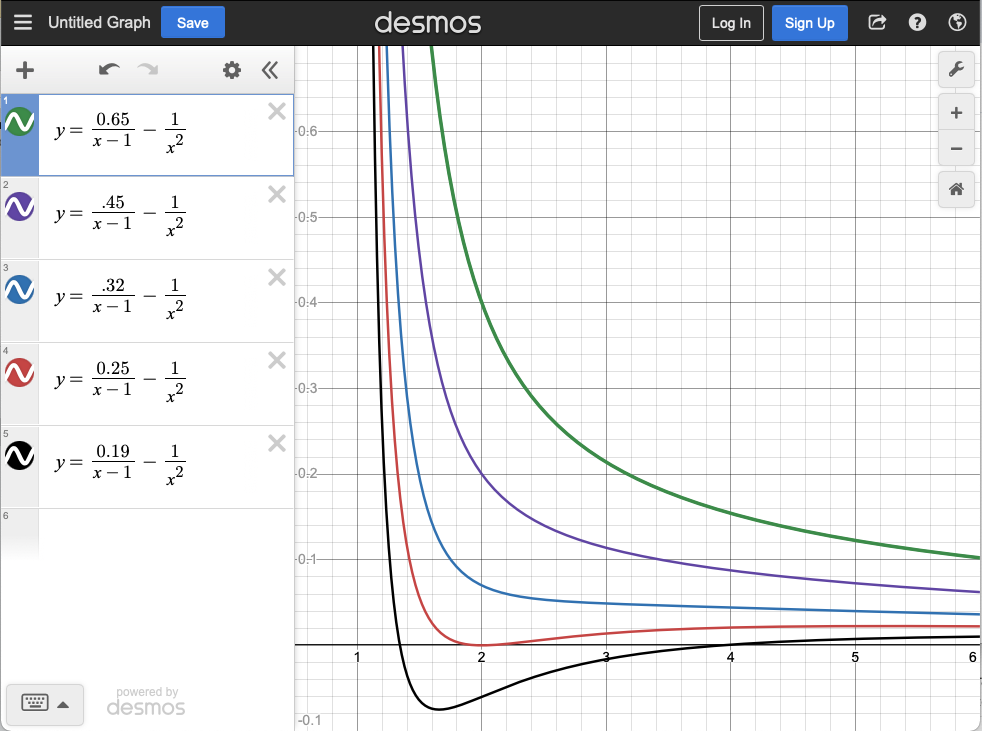
Using your expression from part (a), sketch or plot \(p(V)\) at various fixed temperatures. The volume axis should include \(Nb\) up to \(6Nb\). Your plot can be dimensionless (i.e. \(V/Nb\) on the x axis). Select values of \(NkT\) and \(aN^2\) that give curves with different shapes. Can you create a minima in pressure near \(V = 2Nb\)?
As we did in the last homework we remember that \(dF=-SdT-pdV\), so that we can write:
\begin{equation*}
p=-\left(\frac{\partial F}{\partial V}\right)_{T}
\end{equation*}
We perform he derivative to obtain:
\begin{equation*}
p=-\left(\frac{\partial F}{\partial V}\right)_{T}=N k T\left(\frac{N}{(V-N b) T^{\frac{3}{2}}} \frac{T^{\frac{3}{2}}}{N}\right)-\frac{a N^{2}}{V^{2}}=
\end{equation*}
\begin{equation*}
=N k T \frac{1}{V-N b}-\frac{a N^{2}}{V^{2}}
\end{equation*}
This can be re-organized as:
\begin{equation*}
\left(p+\frac{a N^{2}}{V^{2}}\right)(V-N b)=N k T
\end{equation*}
Which can be confirmed to be the van der Waals equation from, e.g., Wikipedia.
Plotting the curve shapes on Desmos gives:
Some of these curves go to negative pressure, which is interesting to think about. A system with negative pressure must be unstable. Systems will maximize their entropy, subject to any external constraints such as a container with fixed volume. A fluid or gas with negative pressure can increase its entropy by decreasing its volume. Such a system will spontaneously collapse until the pressure again becomes positive.
Ideal gas internal energy
S1 5459S
In this problem, you will prove that the internal energy of an ideal gas depends on temperature, but not on volume, based soley on the ideal gas equation:
\begin{align}
pV &= Nk_BT
\end{align}
and of course your knowledge of thermodynamics. It's a pretty tricky proof, so
I'll step you through it.
To begin with, use the Helmholtz free energy \(F=U-TS\) to show that
\begin{align}
\left(\frac{\partial {U}}{\partial {V}}\right)_{T} &= -p + T\left(\frac{\partial {S}}{\partial {V}}\right)_{T}
\end{align}
for any material.
This first step suggests we use the Helmholtz free energy
\begin{align}
dF &= -SdT -pdV
\end{align}
This means that the pressure is given by
\begin{align}
-p &= \left(\frac{\partial {F}}{\partial {V}}\right)_{T}
\\
&=
\left(\frac{\partial {U-TS}}{\partial {V}}\right)_{T}
\\
&=
\left(\frac{\partial {U}}{\partial {V}}\right)_{T} - T\left(\frac{\partial {S}}{\partial {V}}\right)_{T}
\end{align}
and reordering this gives the equation we were supposed to prove. Note
that this is not the only way you could have proven this, just the most
straightforward.
Now show that for any material
\begin{align}
\left(\frac{\partial {S}}{\partial {V}}\right)_{T} &= \left(\frac{\partial {p}}{\partial {T}}\right)_{V}.
\end{align}
This smells like a Maxwell relation, because it involves terms that are “balanced downstairs” with respect to \(V\) and \(T\). And indeed we can see from the total differential
of \(F\) that
\begin{align}
\left(\frac{\partial {S}}{\partial {V}}\right)_{T}
&= -\left(\frac{\partial {\left(\frac{\partial {F}}{\partial {T}}\right)_{V}}}{\partial {V}}\right)_{T}
\\
&= -\left(\frac{\partial {\left(\frac{\partial {F}}{\partial {V}}\right)_{T}}}{\partial {T}}\right)_{V}
\\
&= \left(\frac{\partial {p}}{\partial {T}}\right)_{V}
\end{align}
Indeed the equation we were asked to show was just a Maxwell relation.
So we've still not assumed an ideal gas.
Finally, show that for an ideal gas
\begin{align}
\left(\frac{\partial {U}}{\partial {V}}\right)_{T} &= 0.
\end{align}
Remember that the only statement we can assume about the ideal gas is \(pV=Nk_BT\). We have not been given an expression for \(U\).
We've been given a couple of very strong hints. So lets put them together:
\begin{align}
\left(\frac{\partial {U}}{\partial {V}}\right)_{T} &= -p + T\left(\frac{\partial {S}}{\partial {V}}\right)_{T}
\\
&= -p + T\left(\frac{\partial {p}}{\partial {T}}\right)_{V}
\\
&= -p + T\frac{Nk_B}{V}\label{eq:use-ideal-gas-law}
\\
&= 0
\end{align}
where in Eq. \ref{eq:use-ideal-gas-law} we use the ideal gas law to compute
the derivative. You can see that this result, in which \(U\) depends on
temperature but not volume, relies on the pressure being strictly proportional
to temperature. In practice, the only family of systems I know of for which
I know this to be true are the ideal gas.
Non-Ideal Gas
S1 5459S
The equation of state of a gas that
departs from ideality can be approximated by
\[ p=\frac{NkT}{V}\left(1+\frac{NB_{2}(T)}{V}\right),
\] where \(B_{2}\) is called the second virial coefficient. \(B_{2}\) is a function of \(T\), so it is usually written as \(B_{2}(T)\). The function \(B_{2}(T)\) increases monotonically with temperature. Find \(\left(\frac{\partial {U}}{\partial {V}}\right)_{T}\) and determine its sign.
We are given the pressure, so we should first ask ourselves what we
know about the pressure. We know that
\begin{align}
dU &= TdS - pdV
\end{align}
and therefore
\begin{align}
p &= -\left(\frac{\partial {U}}{\partial {V}}\right)_{S}
\end{align}
Unfortunately, we are asked about \(\left(\frac{\partial {U}}{\partial {V}}\right)_{T}\), which is
something quite different. We could also consider the Helmholtz
free energy, which gives a second definition of pressure:
\begin{align}
F &= U - TS \\
dF &= -SdT - pdV \\
p &= -\left(\frac{\partial {F}}{\partial {V}}\right)_{T} \\
&= -\left(\frac{\partial {U}}{\partial {V}}\right)_{T} + T \left(\frac{\partial {S}}{\partial {V}}\right)_{T} \\
\left(\frac{\partial {U}}{\partial {V}}\right)_{T} &= T \left(\frac{\partial {S}}{\partial {V}}\right)_{T} - p
\end{align}
This would be great, if we could only find this particular
derivative of the entropy. Fortunately, when we examine the total
differential of the Helmholtz free energy, we can see that this
particular derivative of the entropy is part of a Maxwell relation!
\begin{align}
\left(\frac{\partial {S}}{\partial {V}}\right)_{T} &= \left(\frac{\partial {-\left(\frac{\partial {F}}{\partial {T}}\right)_{V}}}{\partial {V}}\right)_{T} \\
&= \left(\frac{\partial {-\left(\frac{\partial {F}}{\partial {V}}\right)_{T}}}{\partial {T}}\right)_{V} \\
&= \left(\frac{\partial {p}}{\partial {T}}\right)_{V} \\
&= \frac{Nk}{V}\left(1 + \frac{NB_2(T)}{V}\right)
+ \frac{N^2kT}{V^2} \frac{dB_2}{dT} \\
&= \frac{p}{T} + \frac{N^2kT}{V^2} \frac{dB_2}{dT} \\
\end{align}
Putting these together, we find that
\begin{align}
\left(\frac{\partial {U}}{\partial {V}}\right)_{T} &= T \left(\frac{\partial {S}}{\partial {V}}\right)_{T} - p
\\
&= T\left(\frac{p}{T} + \frac{N^2kT}{V^2} \frac{dB_2}{dT}\right) - p
\\
&= \frac{N^2kT^2}{V^2} \frac{dB_2}{dT}
\end{align}
Since we are told that \(B_2(T)\) is a monotonically increasing
function, its slope is always positive, and the internal energy
increases as we increase the volume at fixed temperature. i.e.
\begin{align}
\left(\frac{\partial {U}}{\partial {V}}\right)_{T} \ge 0
\end{align}
Plastic Rod
S1 5459S
When stretched to a length \(L\) the tension force
\(\tau\) in a plastic rod at temperature \(T\) is given by its Equation of
State
\begin{equation*}
\tau = a T^{2} (L - L_{o})
\end{equation*}
where \(a\) is a positive constant and \(L_{o}\) is the rod's
unstretched length. For an unstretched rod (i.e. \(L = L_{o}\)) the
heat capacity at constant length is \(C_{L}=bT\) where \(b\) is a
constant. Knowing the internal energy at \(T_{o}, L_{o}\) (i.e.
\(U(T_{o},L_{o})\)) find the internal energy
\(U(T_{f},L_{f})\) at some other temperature \(T_{f}\) and length
\(L_{f}\).
(1 point) Write an expression for the exact differential \(dU\) in terms of \(dT\) and \(dL\) (we've been calling this type of expression an “overlord equation”).
Show that the partial derivative \((\partial U / \partial
L)_{T} = -aT^{2}(L-L_{o})\).
For a derivative at constant \(T\), we will want to compare with
the free energy, since it is naturally a function of \(T\) and \(L\)
\begin{align}
F &= U - TS \\
dF &= -SdT + \tau dL.
\end{align}
Since \(\tau\) is the coefficient in front of \(dL\),
\begin{align}
\tau &= \left(\frac{\partial {F}}{\partial {L}}\right)_{T}, \\
&= \left(\frac{\partial {U}}{\partial {L}}\right)_{T} - T\left(\frac{\partial {S}}{\partial {L}}\right)_{T}\label{eq:has-dUdLT},
\end{align}
which gets us close to finding the derivative we are seeking.
Equation \ref{eq:has-dUdLT} has a derivative of entropy that is a bit
inconvenient (since we have no expression for entropy).
But we can simplify it by identifying the Maxwell relation that
comes from the Helmholtz free energy:
\begin{align}
-\left(\frac{\partial {S}}{\partial {L}}\right)_{T}
&= \left(\frac{\partial {\left(\frac{\partial {F}}{\partial {T}}\right)_{L}}}{\partial {L}}\right)_{T}
\\
&= \left(\frac{\partial {\left(\frac{\partial {F}}{\partial {L}}\right)_{T}}}{\partial {T}}\right)_{L}
\\
&= \left(\frac{\partial {\tau}}{\partial {T}}\right)_{L}
\end{align}
So now we can plug this into Eq. \ref{eq:has-dUdLT} to find
\begin{align}
\tau &= \left(\frac{\partial {U}}{\partial {L}}\right)_{T} + T\left(\frac{\partial {\tau}}{\partial {T}}\right)_{L} \\
\left(\frac{\partial {U}}{\partial {L}}\right)_{T} &= \tau - T\left(\frac{\partial {\tau}}{\partial {T}}\right)_{L} \\
&= a T^{2} (L - L_{o}) - T\left(2 a T (L - L_{o})\right) \\
&= - a T^{2} (L - L_{o})
\end{align}
Integrate \(dU\) very carefully in the \(T-L\) plane, keeping in mind that \(C_{L} = bT\) holds only at \(L=L_{o}\) to find \(U(T_f,L_f)-U(T_0,L_0)\).
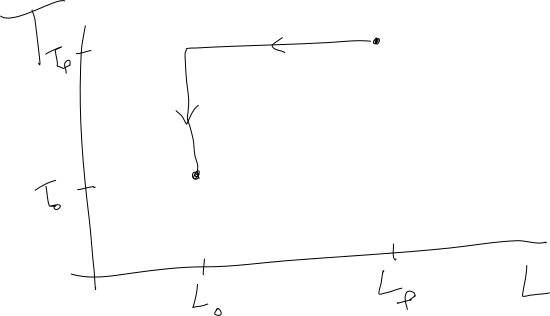
We start by identifying a path to integrate. See figure. We are careful to
choose a path that only changes the temperature while the length is \(L_0\).
The heat capacity at constant \(L\) is \(bT\) as long as \(L\) is
equal to \(L_o\). So we can find the energy at any other
temperature from
\begin{align}
U(T_f,L_o) &= U(T_o,L_o) + \int_{T_o}^{T_f} \left(\frac{\partial {U}}{\partial {T}}\right)_{L}dT
\\
&= U(T_o,L_o) + \int_{T_o}^{T_f} bT dT \\
&= U(T_o,L_o) + \frac{b}{2} \left(T_f^2 - T_o^2 \right)
\end{align}
Now we just need to integrate in the \(L\) direction, keeping in mind that the
temperature is \(T_f\) during this part of the path.
\begin{align}
U(T_f,L_f) &= U(T_f,L_o) + \int_{L_o}^{L_f} \left(\frac{\partial {U}}{\partial {L}}\right)_{T}dL
\\
&= U(T_f,L_o) + \int_{L_o}^{L_f} - a T_f^{2} (L - L_{o}) dL \\
&= U(T_f,L_o) - \frac{a T_f^2}{2} \left(L_f-L_o \right)^2 \\
U(T_f,L_f) &= U(T_o,L_o)
+ \frac{b}{2} \left(T_f^2 - T_o^2\right)
- \frac{a T_f^2}{2} \left(L_f-L_o \right)^2
\end{align}