Student handout: Divergence and Curl
Vector Calculus II 2021
- group Small Group Activity 30 min. Student handout (PDF)
-
Physics Topics:
- Mathematical Tools > Multivariable Calculus > Line Integral
- Mathematical Tools > Vector Calculus > Curl
- Mathematical Tools > Vector Calculus > Divergence
- Mathematical Tools > Vector Calculus > Divergence Theorem
- Mathematical Tools > Vector Calculus > Stokes' Theorem
- Mathematical Tools > Vector Calculus > Vector Field
-
Is \(\oint\boldsymbol{\vec{F}}\cdot d\boldsymbol{\hat{r}}\) positive, negative, or zero?
-
Will a paddlewheel spin if placed inside your loop, and, if so, which way?
Do you think \(\nabla\times\boldsymbol{\vec{F}}\) is zero or nonzero inside your loop?
Explain.
- Compute \(\nabla\times\boldsymbol{\vec{F}}\). Did you guess right? Explain.
- Is \(\oint\boldsymbol{\vec{F}}\cdot\boldsymbol{\hat{n}}\,ds\) positive, negative, or zero? (\(\boldsymbol{\hat{n}}\) is the outward pointing normal vector to \(C\).)
- Is the net flow outwards across your loop positive, negative, or zero?
- Do you think \(\nabla\cdot\boldsymbol{\vec{F}}\) is zero or nonzero inside your loop? Explain.
- Compute \(\nabla\cdot\boldsymbol{\vec{F}}\). Did you guess right? Explain.
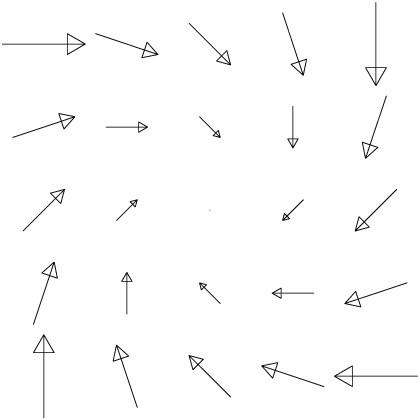
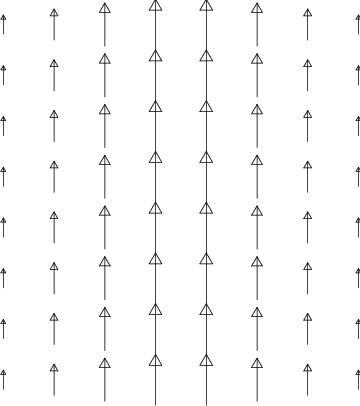
- Repeat the above steps for vector fields \(\boldsymbol{\vec{G}}\) and \(\boldsymbol{\vec{H}}\) chosen from the second and third columns.
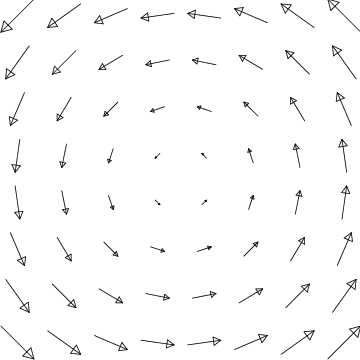
|
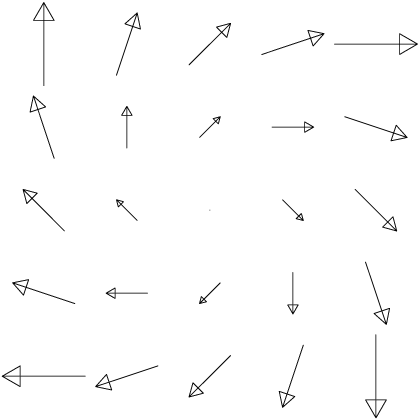
|
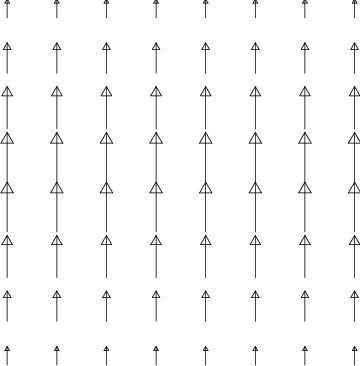
|
| \(-y\,\boldsymbol{\hat{x}}+x\,\boldsymbol{\hat{y}}\) | \((x+y)\,\boldsymbol{\hat{x}}+(y-x)\,\boldsymbol{\hat{y}}\) | \(e^{-y^2}\,\boldsymbol{\hat{y}}\) |
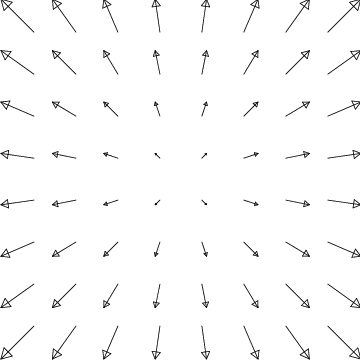
|
|
|
| \(x\,\boldsymbol{\hat{x}}+y\,\boldsymbol{\hat{y}}\) | \((y-x)\,\boldsymbol{\hat{x}}-(x+y)\,\boldsymbol{\hat{y}}\) | \(e^{-x^2}\,\boldsymbol{\hat{y}}\) |
- Keywords
- Learning Outcomes
-