Student handout: Velocity and Acceleration in Polar Coordinates
Central Forces 2021
Use geometry to find formulas for velocity and acceleration in polar coordinates.
- group Small Group Activity 10 min. Tabletop Whiteboard with markers,A handout for each student Student handout (PDF)
- Physics Topics:
What students learn
Students derive expressions for the velocity and acceleration in polar coordinates. Along the way, students discover:
- Since \(\hat{r}\) and \(\hat{\phi}\) are functions of position in space, if these basis vectors are being used to describe the position of a particle as a function of time, then \(\hat{r}\) and \(\hat{\phi}\) can also depend on time.
- To find how \(\hat{r}\) and \(\hat{\phi}\) depend on time, it is easiest to express them in terms of rectangular basis vectors \(\hat{x}\) and \(\hat{y}\), which do not depend on either position or time.
On the figure below, draw \(\hat{s}\) and \(\hat{\phi}\) at \(P\).
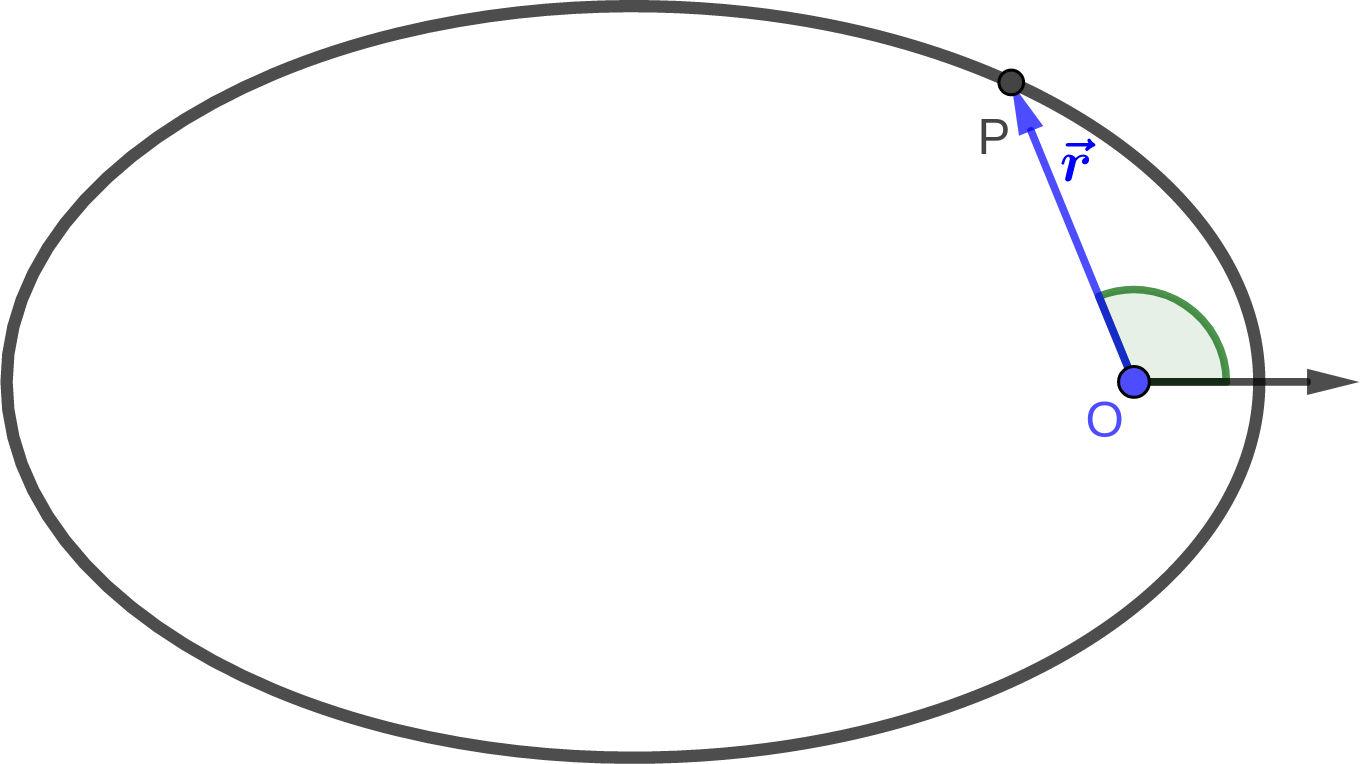
- Find \(\frac{d}{dt}\hat{s}\) and \(\frac{d}{dt}\hat{\phi}\) in terms of \(\hat{s}\) and \(\hat{\phi}\).
- Find \(\vec{v}\) in terms of \(\hat{s}\) and \(\hat{\phi}\).
- Keywords
- Learning Outcomes
-