Quantum Fundamentals: NoTerm-NEW
Complex Number Practice (SOLUTION): Due Day 3 W 2/15 Math Bits
- Complex Numbers: Rectangular Form
S1 4648S
For the complex numbers \(z_1=3-4i\) and \(z_2=7+2i\), compute:
- \(z_1-z_2\)
\begin{align} z_1-z_2&=(3-4i)-(7+2i)\\ &=(3-7)+(-4-2)i\\ &=-4-6i \end{align}
- \(z_1 \, z_2\)
\begin{align} z_1 \, z_2&=(3-4i)(7+2i)\\ &=21+6i-28i+8\\ &=29-22i \end{align}
- \(\frac{z_1}{z_2}\)
\begin{align} \frac{z_1}{z_2}&=\frac{3-4i}{7+2i}\\ &=\frac{3-4i}{7+2i}\,\frac{7-2i}{7-2i}\\ &=\frac{21-6i-28i-8}{49-14i+14i+4}\\ &=\frac{13-34i}{53} \end{align}
- \(z_1-z_2\)
- Circle Trigonometry and Complex Numbers
S1 4648S
Find the rectangular coordinates of the point where the angle \(\frac{5\pi}{3}\) meets the unit circle. If this were a point in the complex plane, what would be the rectangular and exponential forms of the complex number? (See figure.)
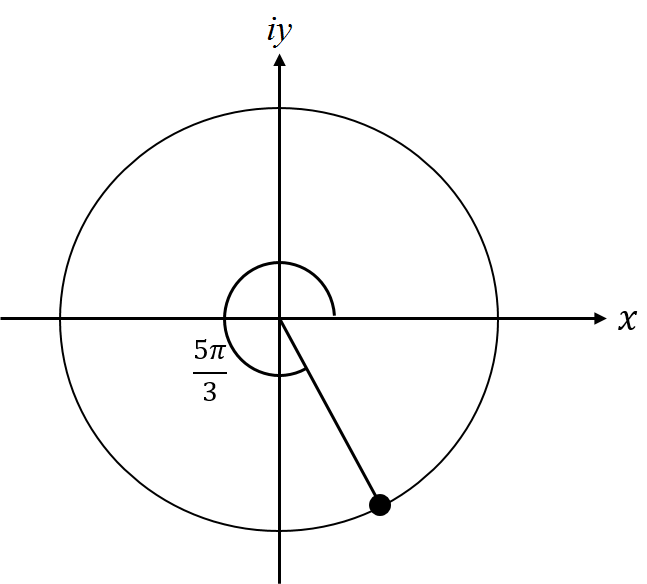
If this were a point in the complex plane, the \(y\) coordinate would correspond to the imaginary component and the \(x\) coordinate would be the real component. I can find the rectangular form by comparing the formulae for rectangular and polar forms of a complex number:
\begin{align*} z &= x + iy\\ &= \cos\theta + i\sin\theta\\[12pt] x &= \cos\left(\frac{5\pi}{3}\right) =\frac{1}{2}\\ y &= \sin\left(\frac{5\pi}{3}\right) =-\frac{\sqrt{3}}{2}\\ \end{align*}
This gives the complex number in rectangular form (\(x+iy\)) as
\[z = \frac{1}{2}-i\frac{\sqrt{3}}{2}\].
The exponential form (\(re^{i\phi}\)) of the complex number would have a magnitude of 1 (since it's on the unit circle) and an angle of \(\frac{5\pi}{3}\) to give:
\begin{align*} z &= 1e^{i5\pi/3}\\ &=e^{i5\pi/3} \end{align*}
- Complex Number Algebra, Exponential to Rectangular--Practice
S1 4648S
If \(z_1=5e^{7i\pi/4}\), \(z_2=3e^{-i\pi/2}\), and \(z_3=9e^{(1+i\pi)/3}\), express each of the following complex numbers in rectangular form, i.e. in the form \(x+iy\) where \(x\) and \(y\) are real.
-
\(
z_1 +z_2
\)
It's easiest to do addition in rectangular form, so change the form at the beginning of the problem. Make sure you know the sign and cosine of special angles like multiples of \(\frac{\pi}{4}\).
\begin{align*} z_1&=5e^{7i\pi/4}\\ &=5\left(\cos \frac{7\pi}{4}+i\sin \frac{7\pi}{4}\right)\\ &=5\frac{\sqrt 2}{2}\left(1-i\right) \end{align*}
-
\(
z_1 z_2
\)
It's easiest to do multiplication in exponential form, so change the form to rectangular AFTER doing the multiplication. \begin{align*} z_1 z_2&=5e^{7i\pi/4}\, 3e^{-i\pi/2}\\ &=15e^{(7-2)i\pi/4}\\ &=15\left(\cos \frac{5\pi}{4}+i\sin \frac{5\pi}{4}\right)\\ &=-15\frac{\sqrt 2}{2}\left(1+i\right) \end{align*}
-
\(
\frac{z_2}{z_3}
\)
It's easiest to do division in exponential form, so change the form to rectangular AFTER doing the division. \begin{align*} \frac{z_2}{z_3}&=\frac{3e^{-i\pi/2}} {9e^{(1+i\pi)/3}}\\ &=\frac{1}{3}\,e^{-3i\pi/6}\, e^{-3}\, e^{-2i\pi/6}\\ &=\frac{1}{3}\, e^{-3}\, \left(\cos \frac{5\pi}{6}-i\sin \frac{5\pi}{6}\right)\\ &=-\frac{1}{6}\, e^{-3}\, \left(\sqrt{3}+i\right) \end{align*}
-
\(
z_1 +z_2
\)
- Complex Numbers, All Forms--Practice
S1 4648S
Represent the following four complex numbers in rectangular form \(a + ib\), exponential form \(|z|e^{i\phi}\) , and on an Argand diagram:
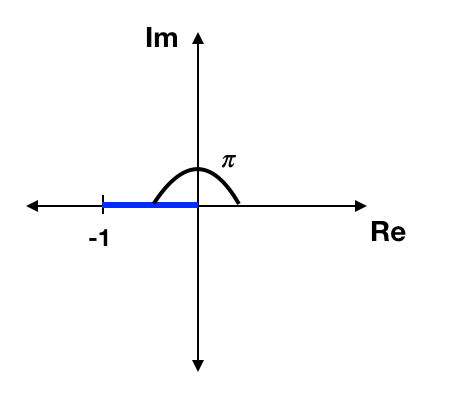
\(e^{i\pi}\)
Rectangular Form: \begin{eqnarray*} e^{i\pi} &=& \cos\pi +i\sin\pi\\ &=& -1+0\\ &=&-1 \end{eqnarray*}
Exponental Form: Already in Exponential Form!
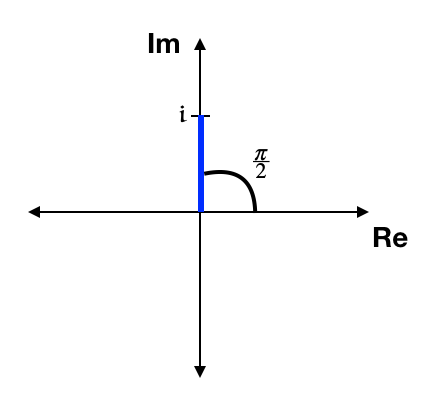
\(i\)
Rectangular Form: Already in Rectangular Form! \begin{eqnarray*} a+ib &=& 0+i(1))\\ &=& i\\ \end{eqnarray*}
Exponental Form: \begin{eqnarray*} i &=& \cos\frac{\pi}{2} +i\sin\frac{\pi}{2}\\ &=& e^{i\frac{\pi}{2}}\\ \end{eqnarray*}
\(\sin\frac{\pi}{2}\)
Rectangular Form: Already in Rectangular Form! Just evaluate the trig function. \begin{eqnarray*} a+ib &=& \sin\frac{\pi}{2}+i(0)\\ &=& \sin\frac{\pi}{2}\\ &=& 1\\ \end{eqnarray*}
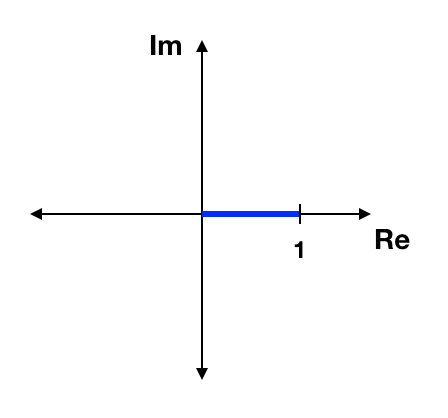
Exponental Form: The number is pure real, so the imaginary part is zero, and I need the real part to return 1. \begin{eqnarray*} \sin\frac{\pi}{2} &=& \cos(0) +i(0)\\ &=& e^{i(0)}\\ \end{eqnarray*}
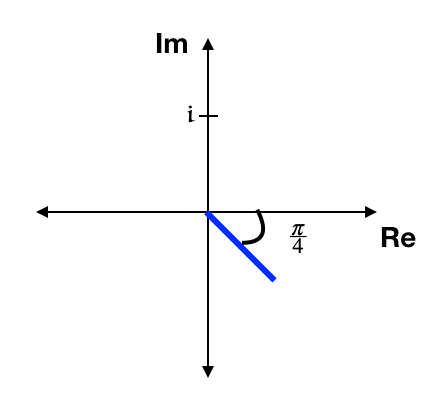
\(\cos\frac{\pi}{4}-i\sin\frac{\pi}{4}\)
Rectangular Form: Already in Rectangular Form! Just evaluate the trig functions. \begin{eqnarray*} a+ib &=& \cos\frac{\pi}{4}-i\sin\frac{\pi}{4}\\ &=& \frac{\sqrt{2}}{2}-i\frac{\sqrt{2}}{2}\\ \end{eqnarray*}
Exponental Form: Match the pattern. I need to use the fact that sine is an odd function \(\sin(-x)=-\sin x\) and cosine is an even function \(\cos(-x)=\cos x\):
\begin{eqnarray*} \cos\frac{\pi}{4}-i\sin\frac{\pi}{4} &=& \cos\frac{-\pi}{4}+i\sin\frac{-\pi}{4}\\ &=& e^{-i\frac{\pi}{4}}\\ \end{eqnarray*}