Oscillations and Waves: Spring-2025 HW 4b (SOLUTION): Due W4 D5
Interpreting Parameters of Waves
S1 5217S
\[\psi(x,t)=A\cos{(-kx+\omega t+\phi)}\] for \(A=1\) unit; \(k=2\pi\,m^{-1}\); \(\omega=\pi\,rad/s\). What is the wavelength, period, amplitude of the disturbance (don't forget units)? Discuss the dimensions of \(A\). What value of \(\phi\) makes \(\psi(x,t)=0\) at the origin at \(t=0\)?
\(\lambda=\frac{2\pi}{k}=1\,m\); \(T=\frac{2\pi}{\omega}=2\,s\); \(A=1\) unit of whatever \(\psi\) is.
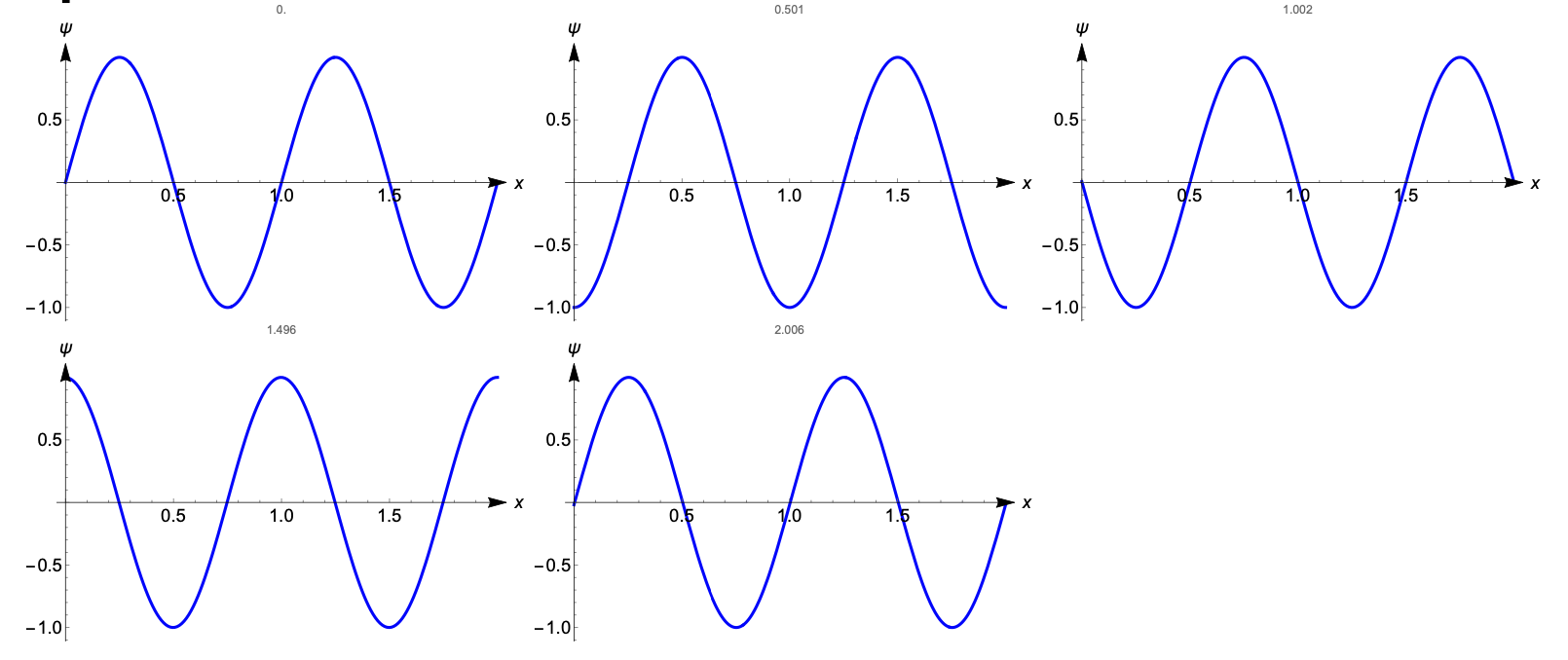
Plot in Mathematica (or similar) two spatial cycles of the waveform and animate for two time periods.
Here \((\phi=\frac{\pi}{2})\) for \(t=0,\,T/4,\,T/2,\,3T/4,\,T\)
Which direction does the wave travel and with what speed? Which direction does it travel if you change the sign of the position term? Of the time term? Of both? Why?
Travels in positive \(x-\)direction because of the relative negative sign between the time and space terms. If you change one of the signs, it moves left, but moves right if you change both.
Focus on the position \(x = 0\,m\). At what rate is the quantity represented by \(y\) changing? (This is called the “material” velocity). Describe the variation of this quantity over one cycle. Is it constant? Or does it change? Can it be positive or negative?
The time variation is itself sinusoidal. That's important because the time variation also obeys the NDWE. The material velocity is zero (changes very little) when the peak or trough passes \(x = 0\). The material velocity is maximal when the string (or whatever it is) passes through zero.
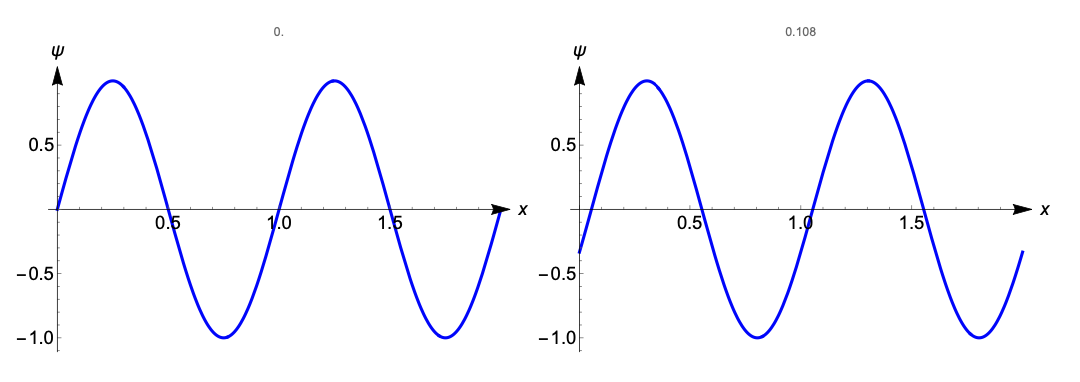
Figure shows waveforms at \(t=0\), \(t=0.1\). Notice the ”particle” at \(x=0\) has moved downwards to almost \(0.5\).
At \(\frac{1}{4}\) cycle, \(\frac{\partial}{\partial t}\psi(0, 1/2\,s)=-\pi \sin{(\pi/2+\pi/2)}=0\) in \(\frac{whatever}{s}\)
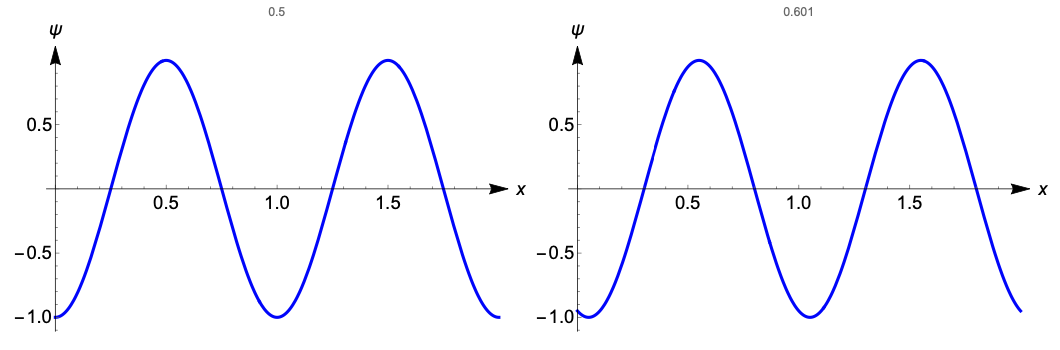
Figure shows waveforms at \(t=0.5\), \(t=0.6\). Notice the “particle” at \(x=0\) has moved very little in the same time period.
At \(1/2\) cycle, \(\frac{\partial}{\partial t}\psi{0, 1\,s}=-\pi\sin{(\pi+\pi/2)}=\pi\) in \(\frac{whatever}{s}\)
At one cycle, \(\frac{\partial}{\partial t}\psi{0, 2\,s}=-\pi\sin{(2\pi+\pi/2)}=-\pi\) in \(\frac{whatever}{s}\)
Forms of Wave Functions
S1 5217S
Write down a sinusoidal waveform \(\psi(x, t)\) that has the following properties:
Amplitude \(2\,m\), wavelength \(10\,m\), travels to the right at \(1\,\frac{m}{s}\), \(\psi=2\,m\) at \(x=5\,m\) and \(t=0\,s\).
\[k=\frac{2\pi}{\lambda}=\frac{2\pi}{10}\text{ ; }\omega=v k=1\frac{m}{s}\frac{2\pi}{10\,m}=\frac{2\pi}{10}s^{-1}\text{ ; }A=2\,m\]
\[\psi(x,t)=2\,m\cos{(\frac{2\pi}{10}x-\frac{2\pi}{10}t+\phi)}\]
\[\psi(5,0)=2\,m=2\,m\cos{(\frac{2\pi}{10}5+\phi)}\text{ which requires } \frac{2\pi}{10}5+\phi=0\text{ and }\phi=-\pi\]
\[\psi(x,t)=2\,m\cos{(\frac{2\pi}{10}x-\frac{2\pi}{10}t-\pi)}\]
Standing wave, amplitude \(5\,m\), period \(1\,s\), wavelength \(1\,m\) that is momentaily flat at \(t=0\,s\).
The velocity (time derivative) is proportional to \(\sin{(2\pi t)}\) which is zero at \(t=0\), so this is the correct choice for the time dependence. There is not enough information to determine \(f\).
Solutions to the Wave Equation
S1 5217S
Describe the following waveforms in words (waveform, period, phase angel, direction, & speed of travel, etc.)
Demonstrate whether they are, or are not, solutions to the non-dispersive wave equation:
\(\frac{\partial^2}{\partial t^2}\psi(x,t)=v^2\frac{\partial^2}{\partial x^2}\psi(x,t)\).
\(\psi(x,t)=4\cos{(4\pi x+3\pi t)}-4\sin{(4\pi x +3\pi t)}\)
This is a solution to the non-dispersive wave equation.
Time derivative:
\begin{align*}
\frac{\partial^2}{\partial t^2}\psi(x,t)&= \frac{\partial^2}{\partial t^2}\Big[4\cos{(4\pi x+3\pi t)}-4\sin{(4\pi x+3\pi t)}\Big]\\
&=-4(3\pi)^2\cos{(4\pi x+3\pi t)}+4(3\pi)^2\sin{(4\pi x+3\pi t)}\\
&=-(3\pi)^2\Big[4\cos{(4\pi x+3\pi t)}-4\sin{(4\pi x+3\pi t)} \Big]
\end{align*}
Space derivative:
\begin{align*}
\frac{\partial^2}{\partial x^2}\psi(x,t)&=\frac{\partial^2}{\partial x^2}\Big[4\cos{(4\pi x+3\pi t)}-4\sin{(4\pi x+3\pi t)}\Big]\\
&=-(4\pi)^2\Big[4\cos{(4\pi x+3\pi t)}-4\sin{(4\pi x+3\pi t)} \Big]
\end{align*}
Thus, with \(v=\frac{\omega}{k}=\frac{3\pi}{4\pi}=\frac{3}{4}\) it's demonstrated that
\[\frac{\partial^2}{\partial t^2}\psi(x,t)=v^2\frac{\partial^2}{\partial x^2}\psi(x,t)\]
obeys the wave equation with \(v=\frac{3}{4}\) wave units. It is a traveling wave and travels to the left. A sum or difference between a sine and cosine of the same argument is indeed sinusoidal. Think about the \(A\) and \(B\) forms we've studied. We can always write
\[A\cos{(\omega t +\phi)}=B_p \cos{(\omega t)}+B_q\sin{(\omega t)}\]
This function has period \(T=\frac{2\pi}{\omega}=\frac{2}{3}\) time units, wavelength \(\lambda=\frac{2\pi}{k}=\frac{1}{2}\) length units, and amplitude \(\sqrt{32}\).
\(\psi(x,t)=3\cos{(2\pi x)}\sin{(\pi t)}\)
Time derivative: \[\frac{\partial^2}{\partial t^2}\psi(x,t)=\frac{\partial^2}{\partial t^2}3\cos{(2\pi x)}\sin{(\pi t)}=-\pi^2 3\cos{(2\pi x)}\sin{(\pi t)}=-\pi^2 \psi(x,t) \]
Space derivative: \[\frac{\partial^2}{\partial x^2}\psi(x,t)=\frac{\partial^2}{\partial x^2}3\cos{(2\pi x)}\sin{(\pi t)}=-(2\pi)^2\psi(x,t) \]
Thus \(\frac{\partial^2}{\partial t^2}\psi(x,t)=\frac{1}{4}\frac{\partial^2}{\partial x^2}\psi(x,t)\), so it obeys \(\frac{\partial^2}{\partial t^2}\psi(x,t)=v^2\frac{\partial^2}{\partial x^2}\psi(x,t)\) with \(v=\frac{1}{2}\) velocity units. \((v=\frac{\omega}{k}=\frac{\lambda}{T}=\lambda f)\)
This disturbance is a sinusoidal wave that does not travel (it is a superposition of two counter-propagating waves each with speed \(\frac{1}{2}\)). it has a period \(T=2\) time units, wavelength \(\lambda=1\) length units, and amplitude \(3\) units. At time \(t=0\), the disturbance is zero everywhere and the material velocity is maximal.
Non-dispersive Triangle Wave
S1 5217S
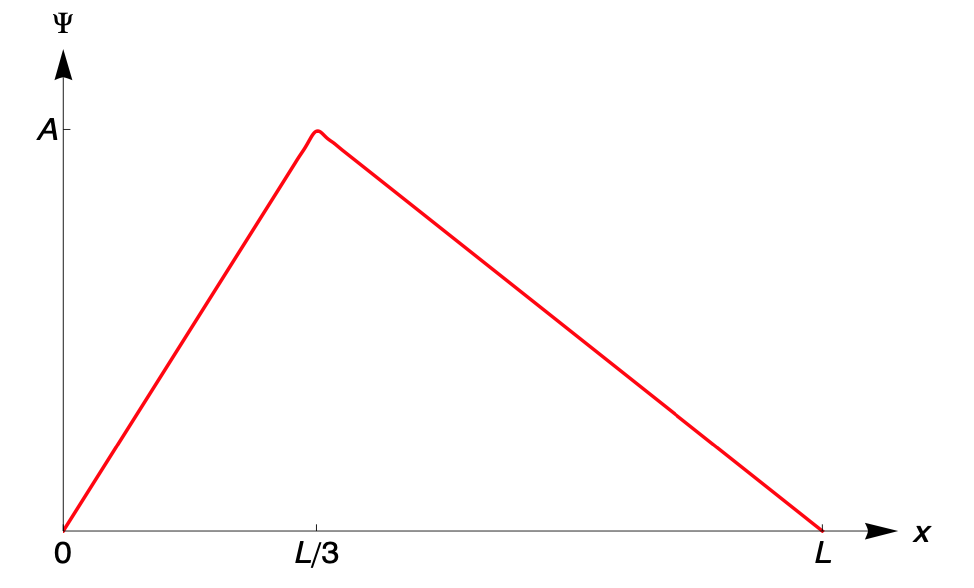
A banjo string (mass per unit length \(\mu\) under tension \(T\)) is anchored at \(x=0\) and \(x=L\). It is displaced so that it has the following profile at \(t=0\), and the transverse velocity at all points is zero at \(t=0\). (The diagram shows a vastly exaggerated displacement -- we assume that \(A<<L\) so that the string stretches only a little and its stretched length is only slightly larger than \(L\).)
Write the wave form as a superposition of standing waves of all \(k\) values (and corresponding frequencies \(\omega_k=vk\)).
I write it as a sum over \(k\) rather than a sum over \(n\) to emphasize that ANY value of \(k\) works in principle, and it is only AFTER the application of boundary conditions that we specialize to the special sum with integer multiples of a fundamental \(k_1\) and \(\omega_1=vk_1\).
\[\psi(x,t)=\sum_k\psi_k(x,t)=\sum_k\Big[A_k\cos{(kx)}\cos{(\omega_kt)}+B_k\cos{(kx)}\sin{(\omega_kt)}+C_k\sin{(kx)}\cos{(\omega_kt)}+D_k\sin{(kx)}\sin{(\omega_kt)}\Big]\]
The information about the initial condition on the velocity eliminates a large number of coefficients. Which ones are zero and why?
The velocity must be a \(\sin{(\omega_kt)}\) at \(t=0\) to satisfy the initial condition, so that \(\psi\) must have \(\cos{(\omega_kt)}\) terms. That means the \(B\) and \(D\) coefficients are zero for every \(k\).
\[\psi(x,t)=\sum_k\Big[A_k\cos{(kx)}\cos{(\omega_kt)}+C_k\sin{(kx)}\cos{(\omega_kt)}\Big]\]
The condition that the string is anchored at \(x=0\) eliminates more coefficients. Which ones are zero and why?
Only \(\sin{(kx)}\) terms force the wave function to be zero at the origin, so all the \(A\) coefficients are also zero.
\[\psi(x,t)=\sum_k C_k\sin{(kx)}\cos{(\omega_k t)}\]
The condition that the string is anchored at \(x=L\) defines special values of \(k\) that are allowed in the sum. Define these special values \(k_n\) in terms of \(L\) and an integer variable \(n\). Rewrite the sum with all this information so that is is now a Fourier sum.
To ensure that the wavefunction is zero at \(x=L\), we need \(\sin{(kL)}=0\rightarrow kL=n\pi\) which defines allowed \(k\) values \(k_n=\frac{n\pi}{L}\), and corresponding angular frequencies \(\omega_n=vk_n\).
\[\psi(x,t)=\sum_nC_n\sin{(k_n x)}\cos{(\omega_n t)}\]
Use Fourier analysis to find the coefficients for this triangle wave at \(t=0\).
At \(t=0\), \(\psi(x,0)=\sum_nC_n\sin{(k_n x)}\).
The shape of the string is (assuming height \(=1\)):
\[\psi(x,0)=
\begin{cases}
\,\,\,\,\,\frac{3x}{L}\,&0<x<\frac{L}{3}\\
\frac{3(L-x)}{2L} &\frac{L}{3}<x<L
\end{cases} \]
The piecewise function can also be written as:
\[\boxed{\psi(x,0)=\sum_nc_n\sin{(\frac{n\pi x}{L})}}\]
The functions \(\sin{(\frac{n\pi x}{L})}\) are orthogonal, which means that \(\int_0^L\sin{(\frac{n\pi x}{L})}\sin{(\frac{m\pi x}{L})}\,dx=\frac{L}{2}\delta_{mn}\), where \(\delta_{mn}\) is the Kronecker delta (\(1\) if \(m=n\), \(0\) otherwise).
Multiply both sides of the boxed equation by \(\sin{(\frac{m\pi x}{L})}\) and integrate from \(0\) to \(L\).
\[\frac{2}{L}\Big[\int_0^{\frac{L}{3}}\sin{(\frac{m\pi x}{L}})\frac{3x}{L}\,dx\,+\,\int_{\frac{L}{3}}^L\sin{(\frac{m\pi x}{L}})\frac{3(L-x)}{2L}\,dx \Big]=c_m\]
Now, the integral on the left, which we have eto evaluate to find \(c_m\), is not particularly hard, but neither is it pleasant. Mathematica can do it for you, or you can look it up.
The result is:
\[\psi(x,0)=\sum_n\frac{9}{n^2\pi^2}\sin{(\frac{n\pi}{3})}\sin{(\frac{n\pi x}{L})}\]
Now write the full \(\psi(x,t)\) making sure you connect the frequency in each term to the \(k\) value in each term.
\[\psi(x,t)=\sum_nC_n\sin{(k_nx)}\cos{(\omega_nt)}\]
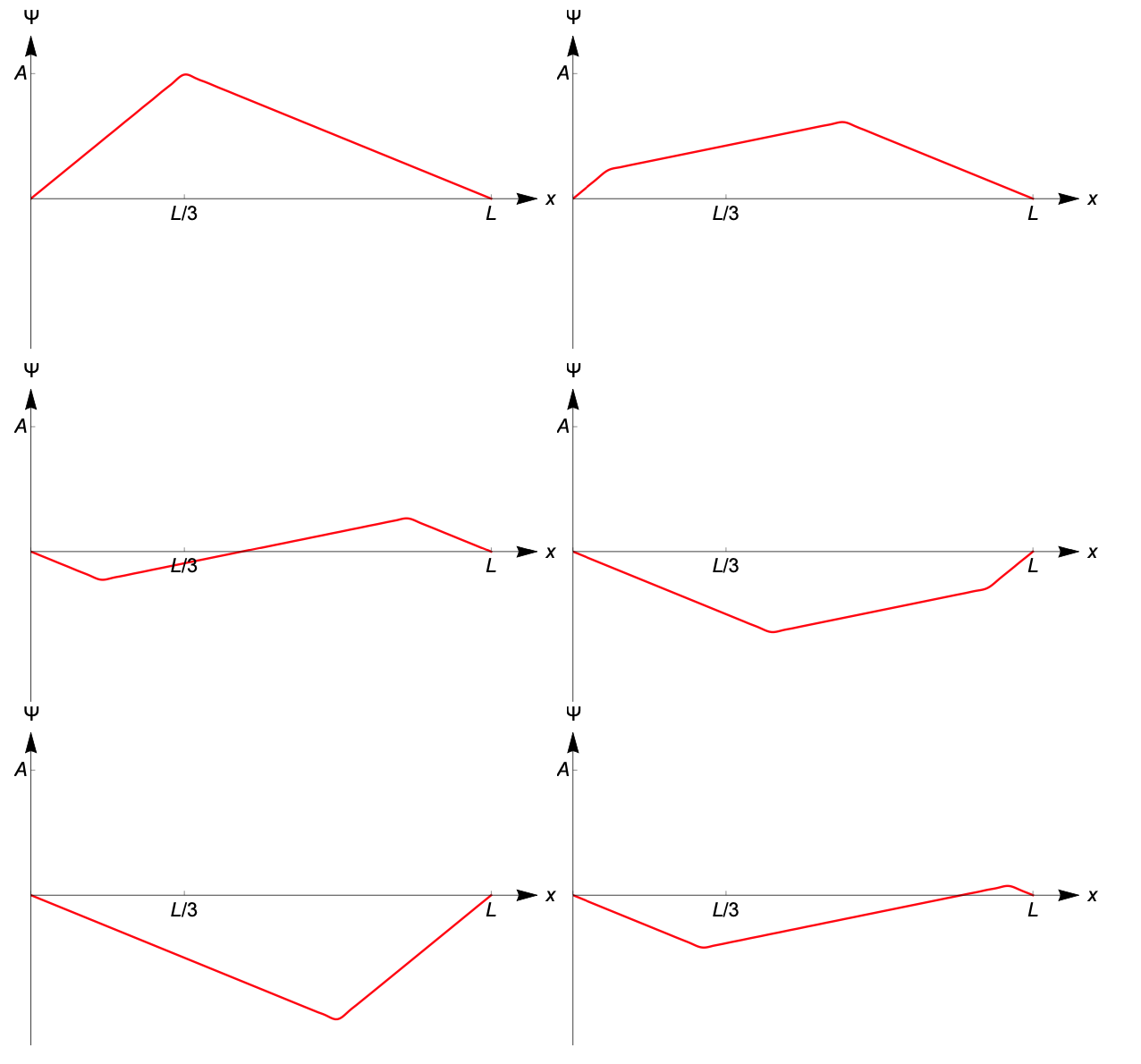
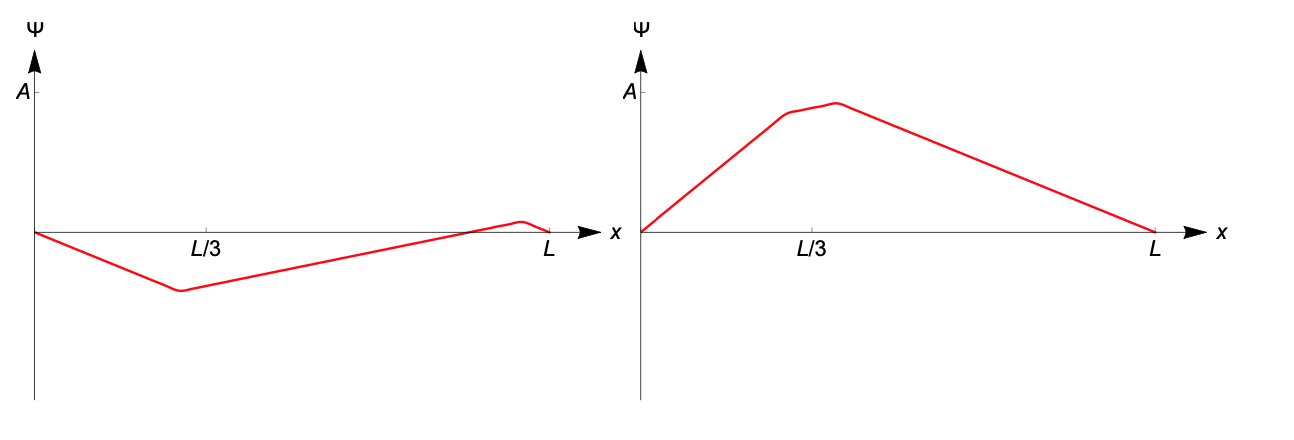
Here are several stills of a complete cycle. You might think that the original shape should remain the same and it should just oscillate with an antinode at \(L/3\). But each component is multiplied by a cosine of different frequency, so the maxima don't always coincide. Instead, think of sine waves propagating at the same speed and they reconstitute the same shape after a time corresponding to the fundamental period.