Energy and Entropy: Fall-2024
HW5 (SOLUTION): Due Day 18 Fri 10/18
- Power from the Ocean
S1 5142S
It has been proposed to use the thermal gradient of the ocean to drive a heat engine. Suppose that at a certain location the water temperature is \(22^\circ\)C at the ocean surface and \(4^{o}\)C at the ocean floor.
- What is the maximum possible efficiency of an engine operating
between these two temperatures?
This is the Carnot efficiency, given by \begin{align} \eta &= 1-\frac{T_C}{T_H} \\ &= 1 - \frac{277}{295} \\ &\approx 6.1\% \end{align}
- If the engine is to produce 1 GW of electrical power, what
minimum volume of water must be processed every second? Note that
the specific heat capacity of water \(c_p = 4.2\) Jg\(^{-1}\)K\(^{-1}\) and the
density of water is 1 g cm\(^{-3}\), and both are roughly constant
over this temperature range.
We start by finding out how much energy it takes to heat up water a gram by 18°C. \begin{align} q &\equiv \frac{Q_{in}}{m} = c_p\Delta T \\ &= 4.2 \text{ J/g/K}\cdot 18\text{ K} \\ &= 75.6\text{ J/g} \end{align} We can then rearrange our equation for efficiency to solve for the mass of the water to find the mass of the water. We can use the value of the efficiency we found in part (a) using the Carnot efficiency equation. \begin{align} \eta & = \frac{W}{Q_{in}} \\ m &= \frac{P\Delta t}{c_p\Delta T \eta} \\ &= \frac{1\text{ GJ}}{75.6 \, \text{ J/g}\cdot 0.061} \\ &\approx 2\times 10^8 \, \text{g} \end{align} Thus the volume of water is \begin{align} V &= m/\rho \\ &= 2\times 10^8 \, \text{cm}^3 \\ &= 200 \, \text{m}^3 \end{align} Two hundred cubic meters per second is a pretty incredible amount of water to cool per second, but not entirely implausible.
- What is the maximum possible efficiency of an engine operating
between these two temperatures?
- Power Plant on a River
S1 5142S
At a power plant that produces 1 GW (\(10^{9} \text{watts}\)) of electricity, the steam turbines take in steam at a temperature of \(500^{o}C\), and the waste energy is expelled into the environment at \(20^{o}C\).
What is the maximum possible efficiency of this plant?
\begin{align} \eta &= 1 -\frac{T_c}{T_H} \\ &= 1 - \frac{293 \text{ K}}{773 \text{ K}} \\ &= 62.096\% \end{align}
Suppose you arrange the power plant to expel its waste energy into a chilly mountain river at \(15^oC\). Roughly how much money can you make in a year by installing your improved hardware, if you sell the additional electricity for 10 cents per kilowatt-hour?
\begin{align} \eta_\text{new} &= 1 -\frac{T_c}{T_H} \\ &= 1 - \frac{288 \text{ K}}{773 \text{ K}} \\ &= 62.743\% \end{align} This gives us an additional power of \begin{align} P_\text{new} &= 1\text{ GW} \frac{62.743\%}{62.096\%} \\ &= 1.01 \text{ GW} \\ P_\text{new} - P_\text{old} &= 10 \text{ MW} \end{align} A year has 8766 hours, so we produce an extra around \(9\times 10^8\) kW-hour, which is worth $10,000,000.
At what rate will the plant expel waste energy into this river?
Let's look at the work and heat in a given second. We know the \(W\), which is 1 GJ, and want to solve for the heat dumped in the cool sink, \(Q_C\). \begin{align} W &= Q_H-Q_C \\ W &= \eta \, Q_H \\ W &= \frac{W}{\eta}-Q_C \\ Q_C &= \left(1 - \frac1\eta \right)W \\ &= \left(\frac1{0.62} - 1\right)10^9 \text{J} \\ &= 6.1\times 10^8 \text{ J} \end{align} So we're expelling energy into the river at \(6.1\times 10^8\) W. Unsurprisingly, this is about the same as the power produced by the plant, since the efficiency is not that far from 50%.
Assume the river's flow rate is 100 m\(^{3}/\)s. By how much will the temperature of the river increase?
This flow rate means that in one second, 100 m3 of water pass by, and we'll give that water \(6.1\times 10^8\) J. \begin{align} Q &= C_p\Delta T \\ &= 4.2 \frac{\text{J}}{\text{g K}} 100 \text{ m}^3 \left(\frac{100\text{ cm}}{1 \text{ m}}\right)^3 \left(\frac{1 \text{ g}}{1 \text{ m}^3}\right)\Delta T \\ \Delta T &= \frac{6.1\times 10^8 \text{J}}{4.2 \frac{\text{J}}{\text{g K}} 100m^3\left(\frac{100 \text{ cm}}{1 \text{ m}}\right)^3 \left(\frac{1 \text{ g}}{1 \text{ cm}^3}\right)} \\ &= 1.45 \text{ K} \end{align} That doesn't seem too bad... but then, a 1 GW plant isn't such a very large plant, and you might wonder what would happen if there are several of these on the same river. And I don't know, maybe fish or algae would be significantly affected by even a temperature change this small.
To avoid this “thermal pollution” of the river the plant could instead be cooled by evaporation of river water. This is more expensive, but it is environmentally preferable. At what rate must the water evaporate? What fraction of the river must be evaporated?
We can look up the latent heat of vaporization of water in Wikipedia, and find a value of 2260 J/g. Thus each second we need to evaporate \begin{align} Q &= mL \\ m &= \frac{Q}{L} \\ &= \frac{6.1 \times 10^8 \text{ J}}{2260 \text{ J/g}} \\ &= 270 \text{ kg} \end{align} This is 270 kg of water, which means \(2.7\times 10^5\) cm3, which corresponds to about a quarter of a cubic meter, which means a quarter of a percent of the water in the river. That doesn't sound so bad, perhaps, and it shouldn't affect the ecosystem so much.
For perspective, the average flow rate of the Willamette is around 1000 m3/s, so this problem involves a smallish stream. On the other hand, a large river is more likely to have many industrial plants along it (e.g. in every city that it passes through).
- Heat Pump
S1 5142S
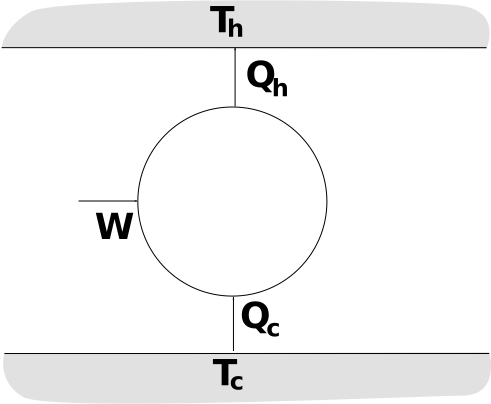
A heat pump is a refrigerator (or air conditioner) run backwards, so that it cools the outside air (or ground) and warms your house. We will call \(Q_h\) the amount of heat delivered to your home, and \(W\) the amount of electrical energy used by the pump.
Define a coefficient of performance \(\gamma\) for a heat pump, which (like the efficiency of a heat engine) is the ratio of “what you get out” to “what you put in.”
We know this is a ratio of what we get out over what we put in. A heat pump heats an already hot area, thus the heat out, \(Q_h\), is what we get out. We have to pay with the work we put in, so we can define the coefficent of performance as: \begin{align} \gamma &\equiv \frac{Q_h}{W} \end{align}
Use the second law of thermodynamics to find an equation for the coefficient of performance of an ideal (reversible) heat pump, when the temperature inside the house is \(T_h\) and the temperature outside the house is \(T_c\). What is the coefficent of performance in the limit as \(T_c \ll T_h\)?
An optimal heat pump will be a reversible heat pump, so the change in entropy of the system plus surroundings will be zero. \begin{align} 0 &= \Delta S_{hot} + \Delta S_{cold} \\ &= \frac{Q_h}{T_h} - \frac{Q_c}{T_c} \\ \frac{Q_c}{Q_h} &= \frac{T_c}{T_h} \end{align} Now we can use the first law to find that \begin{align} W + Q_c &= Q_h \\ W &= Q_h - Q_c \\ \gamma &\equiv \frac{Q_h}{W} \\ &= \frac{Q_h}{Q_h - Q_c} \\ &= \frac{1}{1 - \frac{Q_c}{Q_h}} \\ &= \frac{1}{1 - \frac{T_c}{T_h}} \end{align} This is a bit exciting, since it's greater than one! We get out of a heat pump more than we put in! \(\ddot\smile\) In the limit of low cold temperature, this becomes \begin{align} \eta &\approx 1 + \frac{T_c}{T_h} \end{align} so we don't gain a whole lot. It's always greater than one, since we always can dump the work energy into the hot reservoir (our house).
Discuss your result in the limit where the indoor and outdoor temperatures are close, i.e. \(T_h - T_c \ll T_h\). Does it make sense?
\begin{align} \gamma &= \frac{T_h}{\Delta T} \end{align} When the two temperatures are very close, the efficiency becomes very high, going to infinity when they are equal. This makes sense. For one thing, if the outside temperature was higher than the inside, we could just open the windows and heat our house up with no work needed at all (infinite efficiency!). Or to put it another way, so long as the inside is only slightly warmer than the outside, we aren't gaining much by heating the house.
What is the ideal coefficient of performance of a heat pump when the indoor temperature is \(70^\circ\)F and the outdoor temperature is \(50^\circ\)F? How does it change when the outdoor temperature drops to \(30^\circ\)F?
\begin{align} \gamma &= \frac{1}{1 - \frac{T_c}{T_h}} \\ &= \frac{1}{1 - \frac{273K + (50^\circ F - 32)\frac{5K}{9^\circ F}}{273K + (70^\circ F - 32)\frac{5K}{9^\circ F}}} \\ &= \frac{1}{1 - \frac{283K}{294K}} \\ &= 26.7 \end{align} And when it is freezing outside... \begin{align} \gamma &= \frac{1}{1 - \frac{T_c}{T_h}} \\ &= \frac{1}{1 - \frac{273K + (30^\circ F - 32)\frac{5K}{9^\circ F}}{273K + (70^\circ F - 32)\frac{5K}{9^\circ F}}} \\ &= \frac{1}{1 - \frac{272K}{294K}} \\ &= 13.4 \end{align} So you can see that we lose a lot of efficiency when it gets cold out!
- Violating the Second Law
S1 5142S
It is very common for people to come up with schemes and inventions that violate the Second Law of Thermodynamics. These schemes consistently fail to work, and it is valuable to learn to evaluate whether a scheme will indeed violate the Second Law. In this problem, I'm going to ask you to skim through one or more recent articles, and identify and explain one claim that violates the Second Law. Not every article below contains a violation of the Second Law, so you may need to read more than one article.
- “Physicists build circuit that generates clean, limitless power from graphene” (phys.org)
The title of this article is enough to give you a strong hint that a violation of the Second Law (or less likely the First Law) is proposed. Limitless clean energy generally must have a source, and given that graphene is small, it seems unlikely to give us limitless energy.
There are several quotes that you could use from this article, but I think the simplest might be “An energy-harvesting circuit based on graphene could be incorporated into a chip to provide clean, limitless, low-voltage power for small devices or sensors.” From the context of the article, it is clear that the source of energy proposed is the ambient thermal environment, so this is a plan to extract thermal energy (cooling the environment) and convert it entirely into electrical work. This is by definition the “perfect heat engine” forbidden by the Kelvin formulation of the Second Law. This paragraph up to here would be a sufficient answer. You could also recognize that since the environment is getting cooled, and nothing is getting heated, the change in entropy of system plus environment is negative, violating the Second Law.
- “Fluctuation-induced current from freestanding graphene: towards nanoscale energy harvesting” (arxiv.org)
The title definitely suggests a planned violation of the Second Law, and it is clearly the intent of the authors. However, most of the paper attempts to skirt the issue. It returns, however, in the summary:
“Our model provides a rigorous demonstration that continuous thermal power can be supplied by a Brownian particle at a single temperature while in thermal equilibrium, provided the same amount [emphasis theirs] of energypower is continuously dissipated in a resistor.”
This statement is not entirely clear. If the resistor and the “generator” are at the same temperature, then this simply looks like a misuse of the term “work”. However, unless there is heat flow from the resistor back to the graphene, they will not remain at the same temperature, since dissipated power will heat up the resistor. If the power continues continually without returning via heating, the result will be a violation of the Second Law, as energy spontaneously flows from the cooler graphene to the hotter resistor. - “Fluctuation-induced current from freestanding graphene” (Physical Review E)
This peer-reviewed paper lacks (most of) the “energy harvesting” language that was present in its preprint, making it less obvious that there is intent to violate the Second Law. The sentence quoted above is still present, however, with its implied violation of the Second Law. They will claim that this is not a violation of the Second Law, because both their “Brownian particle” and the resistor are at the same temperature. However, as I said above, the only way that will remain true is if the energy dissipated in the resistor returns to the Brownian particle.
Once you have identified a violation of the Second Law, please write up a short paragraph explaining why it violates the Second Law of Thermodynamics, including a direct quote demonstrating the error. Sometimes it is helpful to construct a scenario in which the proposed invention or observation could be used to heat up a system that is warmer using thermal energy extracted from a system that is cooler.
Hint: papers that claim not to violate the Second Law frequently do.
- “Physicists build circuit that generates clean, limitless power from graphene” (phys.org)