Contemporary Challenges: NoTerm-2023
Homework 8 : Due 26 Friday 11/19
- Reentry Heating of the Space Shuttle
S0 4343S
When NASA's Space Shuttle Orbiter descends from orbit it must pass through the upper reaches of Earth's atmosphere where the air is extremely thin. In this upper atmosphere, air molecules collide with the space shuttle and cause significant heating (transfer of kinetic energy). At very high altitudes, there aren't enough air molecules for convective heat transport. At these altitudes, the primary mechanism for cooling the Orbiter is the emission of blackbody radiation.
The Orbiter has a heat shield on its underside (see the black panels in the photo at the bottom of the page). This heat shield reaches a temperature of 2000 K. The topside of the Orbiter stays cool (\(\approx\) 300 K).
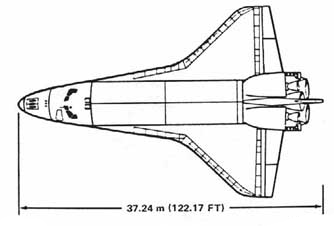
Estimate the maximum rate of decent of the shuttle through the upper atmosphere (the decrease in elevation per unit time). The primary constraint is that the temperature of the heat shield cannot safely exceed 2000 K (glowing red hot). This estimate will require a few steps:
At what rate is blackbody radiation emitted from the Orbiter's heat shield when its underside reaches a temperature of 2000 K? Give your answer in J/s.
Note: the space shuttle is about 35 m long, and has a wingspan (from wingtip to wingtip) of 25 m.
The Orbiter has a velocity component parallel to the Earth's surface, \(v_\parallel\), and a velocity component pointing toward the Earth's surface, \(v_\perp\). To build physical intuition about the descent, let's use reasoning and simple modeling to test some hypotheses about the dominant energy transformations involved. As a first hypothesis, we'll consider a plausible coarse-grained model: assume the Orbiter's total kinetic energy remains constant during reentry, while its gravitational potential energy decreases. Apply the First Law of Thermodynamics (conservation of energy) to estimate the maximum value of \(v_\perp\). Express your answer in units of m/s.
Note: Gravitational potential energy is changing, and electromagnetic radiation energy is being generated. The orbiter's mass is about 80,000 kg, similar to the mass of 80 cars.
Now try analyzing the descent again, this time accounting for the changing kinetic energy of the Orbiter. Use the following information to construct a plausible coarse-grained model. As before, we're using physical reasoning to test hypotheses about the descent, but now incorporating additional detail to better reflect the energy transformations involved. Our goal is to estimate the time required for a safe descent:
Time of ignition for the de-orbit burn is about 60 minutes before landing. The burn lasts 3 to 4 minutes and slows the Orbiter enough to begin its descent. About 30 minutes before landing, the Orbiter begins to encounter the effects of the upper atmosphere and the heat shields start to heat up. This usually occurs at an altitude of about 130 km, more than 8,000 km from the landing site. At this point, the Orbiter is traveling at 7500 m/s relative to the atmosphere. Around 15 minutes before landing, it has descended to an altitude of about 10 km (comparable to the cruising altitude of commercial aircraft) and is traveling at approximately the speed of sound (340 m/s).
Using this new information about changes in velocity and altitude, estimate the time required for “braking with fire” (the hot and fiery segment of the descent). Compare to the actual timeline. What physical mechanisms are still missing from the coarse-grained model of the fiery descent? What would be a sensible next level of model refinement?
- Cosmic Background Radiation
S0 4343S
The universe is filled with thermal radiation that has a blackbody spectrum at an effective temperature of 2.7 K. What is the wavelength of light that corresponds to the peak in \(S_\lambda\) (\(S_\lambda\) is the spectral distribution with respect to wavelength)? In what region of the electromagnetic spectrum is this peak wavelength?
- Efficiency of a solar cell
S0 4343S
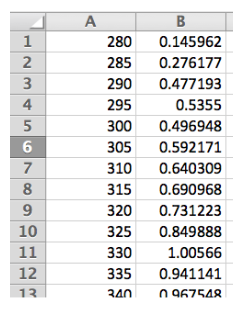
Download the file extraterr_solar.csv, which is in comma-separated-variable (csv) format. Open the csv file in a spreadsheet program such as Excel or Google Sheets. The data is the spectral intensity with respect to wavelength, \(S_\lambda\), for the sunlight that is hitting a satellite above the earth. The first column is wavelength in units of nanometers. The second column is spectral intensity in units of W/(m\(^2\cdot\)nm).
- Use a spreadsheet to perform a simple numerical integration (Riemann sum) to find the total energy flux hitting the satellite. Explain your method using summation notation. Additionally, write down the formula you enter in the spreadsheet (e.g. =SUM(B1:B745)). Give your final answer in units of W/m\(^2\) and check that it is reasonable.
Consider a narrow band of wavelengths, from 552.5 nm to 557.5 nm. (The bandwidth is 5 nm and the central wavelength is 555 nm). All the photons in this bandwidth have very similar energy, \(E_{\text{photon}} \approx\) (1240 nm\(\cdot\)eV)/(555 nm). How many photons per second per \(\text{m}^2\) are in this spectral band of sunlight? Explain your method using standard mathmeatical notation. Additionally, write down the formula that you entered into the spreadsheet.
The calculation that you did for part b can now be applied to every row in your spreadsheet. You will need these numbers for part c.
- Silicon solar cells absorb photons if \(E_{\text{photon}}> 1.1\text{ eV}\). That is to say, \(E_{\text{photon}}\) must be greater than gap between occupied and unoccupied quantum energy levels in silicon. Use your spreadsheet to calculate how many photons per second per \(\text{m}^2\) have sufficient energy to be absorbed by a solar cell. Write down the formula that you entered into the spreadsheet.
- The electrical energy produced by a silicon solar cell cannot exceed
\((1.1\text{ eV})\ \times\text{ (number of absorbed photons)}\).Calculate the maximum possible rate that electrical energy could be produced by a solar cell attached to this satellite per unit area. Give your answer in units of \(\text{W/m}^2\).
- Compare your answers to part a and part d. What is the maximum possible efficiency of the solar cell (i.e. the ratio of the electrical energy output to the total energy input)?