Contemporary Challenges: NoTerm-2023
Homework 3 : Due 11 Friday 10/15
- Hydrocarbon Fuels
S0 4336S
Hydrocarbon fuels have an energy density of about 40 MJ/kg. This means that burning 1 kg of hydrocarbon fuel releases 40 MJ of thermal energy. (For comparison, a modern lithium-ion battery has an energy density of about 0.7 MJ/kg). There are many forms of hydrocarbon fuel: gasoline for cars, wood for campfires, and butter/chocolate/croissants etc. for people.
In class we analyzed a gas-powered car driving at 70 mph (30 m/s). There was a flow of energy going into the kinetic energy of the wind trail behind the car, and an additional flow of heat energy warming the environment. Approximately how many gallons of gas does it take to drive a car 100 miles at this speed? Show how you worked it out, remember that you can't use the equation you derived in class as a starting point.
- Make a similar calculation for a person riding a bicycle. Remember that humans also produce waste heat as they consume hydrocarbon fuel. How many kilograms of chocolate (or similar fuel) would a professional bicycle rider need to travel 100 miles at 20 mph?
- Heat Pump
S0 4336S
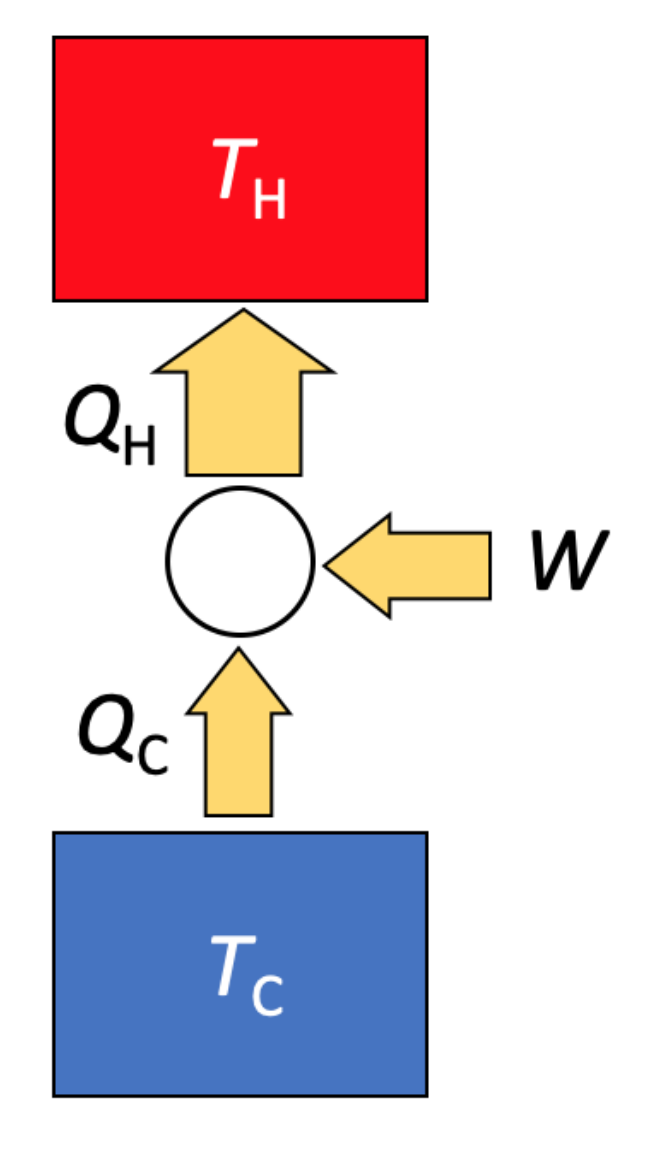
The diagram shows a machine (the white circle) that moves energy from a cold reservoir to a hot reservoir. We will consider whether a machine like this is useful for heating a family home in the winter when the temperature inside the family home is \(T_\text{H}\), and the temperature outside the house is \(T_\text{C}\). To quantify the performance of this machine, I'm interested in the ratio \(Q_\text{H}/W\), where \(Q_{\text{H}}\) is the heat energy entering the house, and \(W\) is the net energy input in the form of work. (\(W\) is the energy I need to buy from the electricity company to run an electric motor). Starting from the 1\(^{\text{st}}\) and 2\(^\text{nd}\) laws of thermodynamics, find the maximum possible value of \(Q_\text{H}/W\). This maximum value of \(Q_\text{H}/W\) will depend solely on the ratio of temperatures \(T_\text{H}\) and \(T_\text{C}\).
Sensemaking: Choose realistic values of \(T_\text{H}\) and \(T_\text{C}\) to describe a family home on a snowy day. Based on your temperature estimates, what is the maximum possible value of \(Q_\text{H}/W\)?
- Entropy Basics
S0 4336S
- (T3B.5) Objects A and B have different temperatures and initial entropies of 22 J/K and 47 J/K. We bring the objects into thermal contact and allow them to come to equilibrium (the objects are isolated from everything else). What is the most quantitative statement that we can make about the combined system's entropy after the two objects come to equilibrium?
- (T3B.8) Suppose that we increase an object's internal energy 10 J by heating the object. The temperature of the object remains roughly constant at 20 C. By how much does the object's entropy increase?
- Multiplicity of an ideal gas
S0 4336S
- (T3M.7) The multiplicity of an ideal monatomic gas with \(N\) atoms, internal energy \(U\), and volume \(V\) turns out to be roughly \begin{align} \Omega (U, V, N) = CV^NU^{\left(\frac{3 N}{2}\right)} \end{align} where \(C\) is a constant that depends on \(N\) alone. Use this expression, together with the fundamental definition of temperature, and they fundamental definition of entropy, to find \(U\) as a function of \(N\) and \(T\) for an ideal gas.
- (From the GRE PhysicsSubject GR0177, given in 2001)
Note 1: The irreversibility of this process tells you that entropy must go (up or down?).
Note 2: The gas constant, \(R\), is equal to Avagadro's number times \(k_B\).
- Integration Techniques
S0 4336S
You should be familiar with three techniques for calculating integrals
- Equations and calculus
- Geometric shapes (calculating a generalized area)
- Simple numerical integration (a sum of \(y\)-values appropriately weighted by \(\Delta x\))
For the following three questions, pick the most appropriate integration technique. You'll be using a different technique for each question.
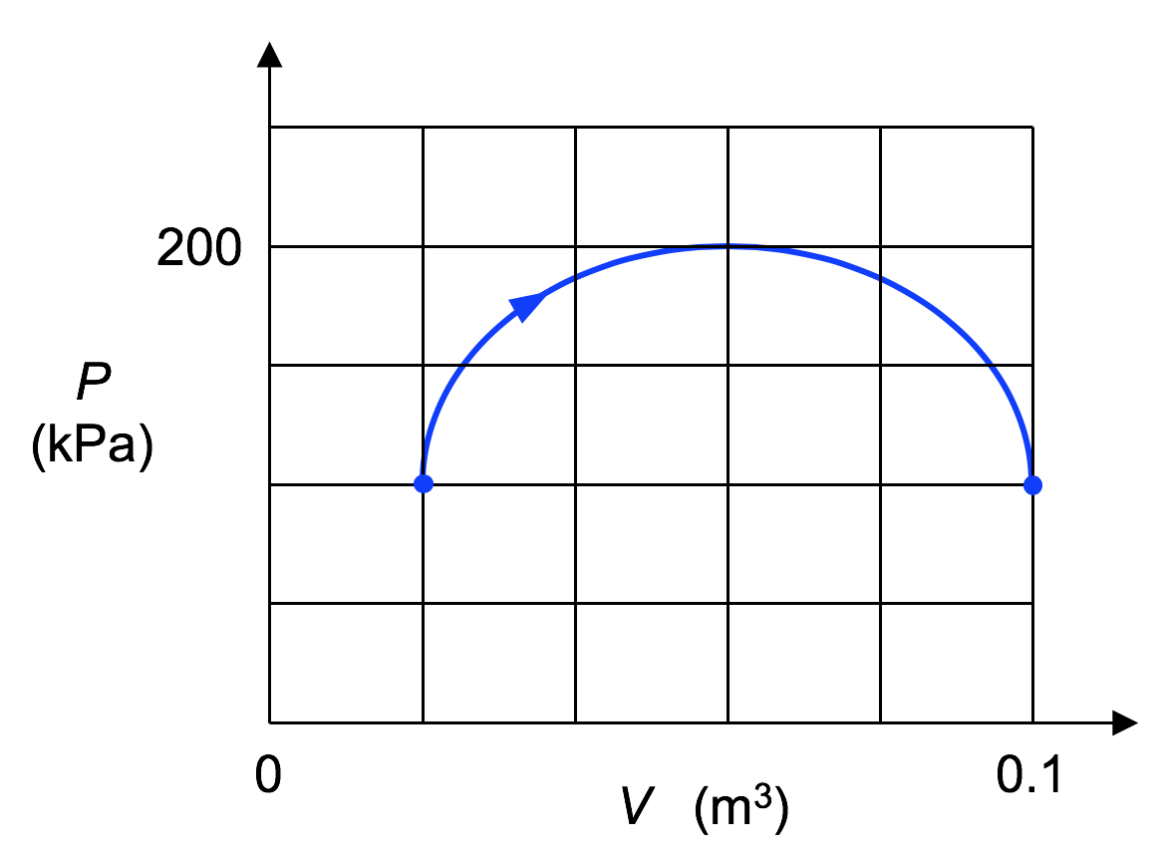
The blue curve on the PV diagram shows the pressure and volume of a gas over some period of time. The arrow indicates the direction from the initial state to the final state. Find the work energy going in (or out) of the gas to within \(\pm 5\%\). Use the standard sign convention to indicate which direction the energy is moving. Check the sign and units of your answer.
Consider compression of a gas for which the P-V trajectory follows the line \(P = (constant)\cdot V^{-5/3}\). The initial volume is 0.1 m\(^3\) and the final volume is final volume is 0.05 \(m^3\). The initial pressure is 100 kPa. Find the work done (use the standard sign convention). Check the sign and units of your answer.
- The following pressure and volume data were measured inside a cylinder of a 1.6-liter 4-cylinder engine. During an 8 ms time period, \(P\) and \(V\) were measured 8 times. The number of gas molecules inside the cylinder was fixed. Estimate the work done during the 8 ms time period (use the standard sign convention). Don't over-complicate this question, use a numerical integration technique that is reasonably accurate, but still simple to implement.
Time (ms) \(P\) (kPa) \(V\) (liters) 0 5000 0.05 1 3500 0.10 2 2500 0.15 3 1700 0.20 4 1100 0.25 5 600 0.30 6 400 0.35 7 300 0.40