Contemporary Challenges: NoTerm-2023
Homework 1 : Due 5 Friday 10/1
- Tea kettle
S0 4334S
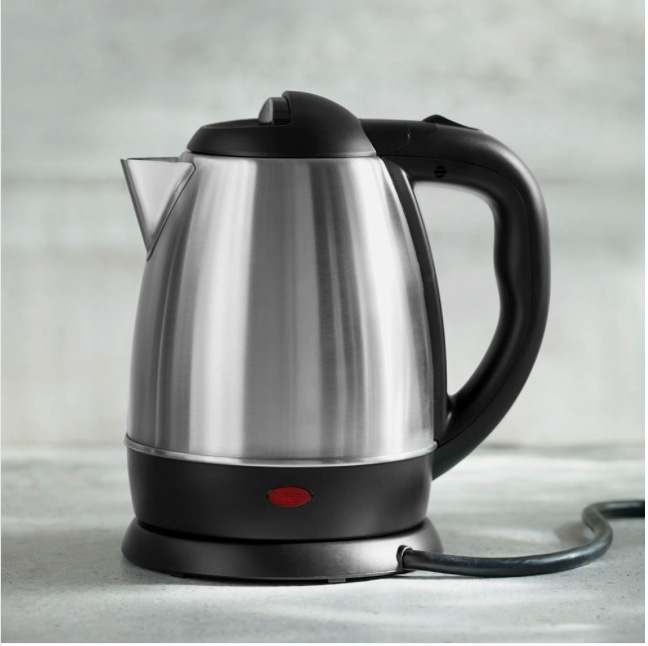
Consider the electric kettle shown in the picture. There is 1 kg of water in the kettle (4 cups of water). This electric kettle transfers energy to the water by heating. The rate of energy transfer is 1000 J/s. The specific heat capacity of water is 4.2 J/(g.K). Calculate the rate that the water temperature rises. Give your answer in units of kelvin/s.
Note: This is an exercise in proportional reasoning. You should not need to look up any formulas.
Sense-making: Put it in context---At this rate, how long would it take to heat up a kettle for making tea? Does this seem like a realistic number? - Piano tuners in Chicago
S0 4334S
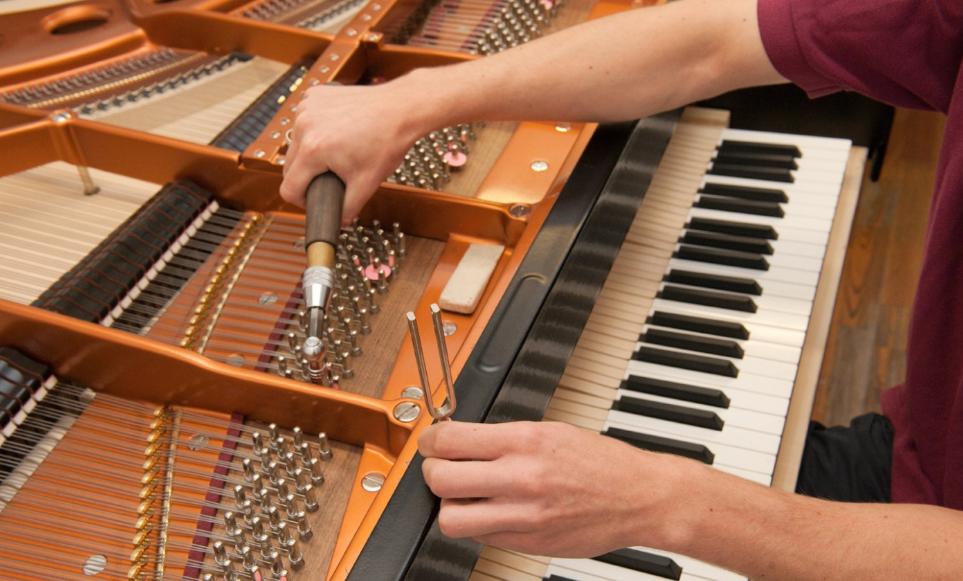
In a fabled story about Enrico Fermi (famous physicist), Fermi was asked how many people work as piano tuners in Chicago. Fermi did some mental arithmetic and quickly answered the question with surprising accuracy. Your task is to recreate Fermi's calculation.
Fermi's approach to solving such problems has spread far beyond the physics community. Today, tech companies and business consulting companies expect their employees to do Fermi problems: https://www.youtube.com/watch?v=KAo6Vn5bDF0.
Background: Pianos were popular when Fermi was living in Chicago in the 1940s. The population of Chicago was about 2 million people. Approximately 1 in 10 households had a piano. Pianos got out of tune at regular intervals (about 2 or 3 years), so the piano owner would call a technician (the piano tuner) to tighten/loosen the 88 strings inside the piano. Each tuning job took at least an hour.
Fermi used his general knowledge to estimate proportionality constants: For example, the number of pianos in Chicago was proportional to the number of households (the proporitionality constant was 0.1.).
To recreate Fermi's calculation make your own quantitaive estimates of proportionality constants (practice using your reasoning skills; avoid using Google). Each proportionality constant will be approximate; that is the essence of this estimation technique. To organize your calculation in a logical, easy-to-follow fashion, set up each line of math with one proportionality constant. For example,
\begin{align} ``(2 \times 10^6 \text{ people}) \div (3 \text{ people per household}) = 0.7 \times 10^6 \text{ households}'' \end{align}
Keep track of units as you go along: households, pianos, hours, etc. Use round numbers at each step of the calculation because a 5% calculational “error” will be smaller than the 10-30% uncertainty in the proportionality constants. How many piano tuners do you think were working in Chicago in the 1940s?
- Wave energy
S0 4334S
The ocean swell lifts water against the force of gravity and makes water move in circular patterns. Energy can be harvested from this ocean swell: gravitational potential energy and kinetic energy are both available (see Chapter F of MacKay). Imagine I draw a line in the ocean that magically absorbs all of the energy associated with the swell, effectively flattening the waves.
If the line is parallel to the crest of the waves and has length \(L\), the time-averaged rate that energy must be absorbed to flatten the swell (energy per time) is \begin{align} \text{energy per time} &= \frac14 \rho g h^2vL \end{align} where \(\rho\) is the density of water, \(g\) is acceleration due to gravity, \(h\) is the height of the wave crest compared to flat water, \(v\) is the velocity of the wave crest. This equation is derived on page 307 of Sustainable Energy by David McKay.
A real device for harvesting wave energy can achieve an efficiency \begin{align} \text{efficiency} &= \frac{0.5\text{ J (electrical energy)}}{1\text{ J (wave energy)}} \end{align} Assume that typical Oregon deep-water waves have \(v = 15\) m/s and \(h = 1\) m. Estimate the electrical power that Oregon could capture if we built wave farms along the entire coast. Give your answer in J/s. There is 10-20% uncertainty in the estimates of \(v\) and \(h\), so the precision of your calculation and final answer should be consistent with respect to this uncertainty.
Sense-making: Make a Comparison---Divide your answer by the population of Oregon. How does the wave energy production rate compare to the rate that people are using energy (see the class notes from Conservation of Energy: First Law of Thermodynamics)?
- Heat loss from a single-family home in winter
S0 4334S
Consider a family home that has a floor area of 50 feet \(\times\) 50 feet, and a ceiling height of 10 feet. The house has typical the insulation for the Pacific Northwest: R-15 walls and an R-30 ceiling.
To help you with physics reasoning, I have converted the R-values into standard-international (SI) units for heat conductance per unit area: \begin{align} \text{wall conductance per unit area} &= 0.4\text{ }\frac{\text{W}}{\text{K}\text{.m}^2}\\ \text{ceiling conductance per unit area} &= 0.2\text{ }\frac{\text{W}}{\text{K}\text{.m}^2} \end{align} Based on the units listed above, and the context (thermal insulation), you can visualize the meaning of these proportionality constants. For example, if there is a 1 kelvin temperature difference between inside/outside the house, every square meter of wall will leak energy at a rate of 0.4 J/s. Doubling the temperature difference, or doubling the wall area, will double the leak rate.
If the indoor temperature is 293 K (68\(^\circ\)F), and the outdoor temperature is 273 K (32\(^\circ\)F), how fast does heat energy leak out of the house (joules/second)? For this question, please assume the floor is perfectly insulated so that no heat leaks out of the floor.
Sense making 1: Three of the most significant categories of human energy use in the United States are (1) the embodied energy of the stuff we buy \(\approx\) 170 MJ/day per person, (2) the energy used driving cars \(\approx\) 140 MJ/day per person, (3) the energy used by jet flights \(\approx\) 100 MJ/day per person (all these energy rates are averaged over the course of a year). How does the heat loss from a family home compare to the other categories on this list?Sense making 2: How many small, portable heaters are needed to heat this house? (assume 1 kW heaters). Does this seem like a realistic number of heaters?
- Three ideas for the term project
S0 4334S
Read the description of the term project on the class website at “Introduction to term project”. Identify three (3) subjects that you find interesting/intriguing (for example, solar energy, exoplanets, ...). Within each subject, pose a question that might have an interesting quantitative answer: “Since it requires energy to make a solar panel, how long does it take to recoup that energy?”, “How far away could we see an Earth-like planet orbiting a Sun-like star?” ... You should turn in 3 different subjects and 3 different quantitative questions (quantitative means “quantities that can be calculated and/or measured”)
Let your mind wander as broadly as possible. Subjects and questions are not restricted to the topics taught in PH315. During this exploratory stage, be bold and daring; you are not committing yourself to solve all 3 questions. To spark your imagination, there is a list of ideas on the class website. The instructor will read your ideas and give you feedback. Whenever possible, the feedback will point you towards a coarse-grained model that is helpful for answering your question. Use the feedback to help decide which question you will develop further (or whether you need to go back to the drawing board).