Contemporary Challenges: Fall-2024
Homework 6 (SOLUTION): Due 26 Friday 11/22
- Solar Sail
S1 5091S
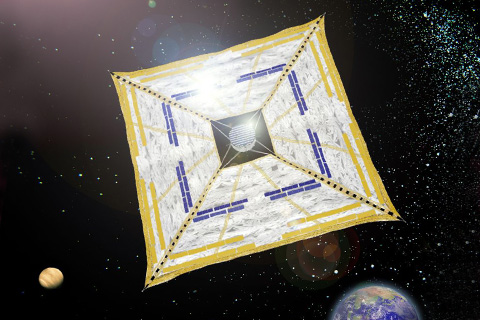
The first spacecraft using a solar sail for propulsion was launched in 2010. Its name is IKAROS. It has a square sail with dimensions 14 m x 14 m. Assume that the sail's mass is 2 kg and it reflects 100% of incident photons. When IKAROS is loaded with other equipment, the total mass of the vehicle is 10 kg. The sail is orientated to receive maximum light from the sun.
- Calculate the momentum of the photons that come from the sun and hit the solar sail in 1 second. Assume a solar intensity of 1300 J/(s.m\(^2\)).
- How much momentum will be transferred from solar photons to IKAROS in one day? Give a numerical answer in units of kg.m/s (assume a constant solar intensity).
- What is the change in the solar sail's velocity in one day? (assume that acceleration is only caused by sunlight).
First, find the energy hitting the solar sail in one second \begin{align} \text{Energy}=1300 \text{ J/(m\(^2\).s)} \times 1 \text{ s} \times200 \text{ m}^2 = 2.6 \times 10^{5} \end{align} \begin{align} \text{Momentum}=\frac{E}{c}=\frac{2.6 \times 10^{5} \text{ J}}{3 \times 10^8 \text{ m/s}} \approx 10^{-3} \text{ kg.m/s} \end{align}
The photons are reflected (reverse their direction), so the solar sail must receive twice the incoming momentum (for conservation of momentum to be satisfied). So, I mulltiply by 2. There are 86000 seconds in a day, so I also multiply by 86000. \begin{align} \text{Momentum transfer per day} = 8.6 \times 10^4 \times 2 \times 10^{-3} \text{ kg.m/s} \approx 150 \text{ kg.m/s} \end{align}
The spacecraft has a mass of 10 kg, so the change in velocity in one day must be 15 m/s.
- Human Vision
S1 5091S
(Q4M.5 from textbook) Suppose you are standing in the dark and facing a \(20 \text{ W}\) LED bulb \(100 \text{ m}\) away. If the diameter of your pupils is about \(8 \text{ mm}\) under these conditions, about how many photons of visible light enter your eye every second?
The visible spectrum of wavelengths is about \(400\text{ nm}-700\text{ nm}\). The middle of this range is 550 nm, so I'll simplify my analysis by assuming all the photons have wavelength 550 nm. The energy of each photon is \begin{align} E_{a}&=\frac{hc}{\lambda_a}\\ &=\frac{(3\times10^8)(6.6\times10^{-34})}{(550\times10^{-9})}\text{ J}\\ &= \frac{2\times10^{-25}}{5.5\times10^{-7}}\text{ J}\\ &=3.6\times10^{-19}\text{ J}\\ \notag\\ \end{align}
the corresponding rates of photon emission from the 20 watt lightbulb \begin{align} R_{a}&=\frac{P}{E_{a}}\\ &=\frac{20}{3.6\times10^{-19}}\text{ s}^{-1}\\ &=5.6\times10^{19}\text{ s}^{-1}\\ \notag \\ \end{align}
The surface area of the sphere with radius \(100\text{ m}\) is \begin{align} S_1 = 4\pi 100^2 \text{ m}^2=130000\text{ m}^2 \end{align} and the area of the pupil is \begin{equation} S_2 = \pi \left(\frac{8}{2}\right)^2 \text{mm}^2=50 \text{ mm}^2 = 5\times10^{-7}\text{ m}^2 \end{equation} So the portion of the light from the bulb that enters the eye is approximately \begin{equation} \frac{S_2}{S_1} = \frac{5\times10^{-7}}{1.3\times10^5} =4\times10^{-12} \end{equation} So the number of photons that enters the eye is approximately, \begin{align} (4\times10^{-12})\times (5.6 \times 10^{19}) = 1.6\times10^8\text{ s}^{-1} \end{align}
This is easily visible to the human eye (the human eye could see a point source emitting \(1.5 \times 10^4\) photons per second).