Contemporary Challenges: Fall-2024
Homework 3 (SOLUTION): Due 11 Friday 10/18
- Hot showers and standard deviation
S1 5084S
(a) Estimate the energy used during a typical 10-minute shower in the United States. The dominant variables in this problem are the temperature rise of the water and the flow rate of the showerhead. Develop a coarse-grained model that incorporates these two variables. For simplicity, you may assume: (i) The water heater is 100% efficient at converting electrical energy into heat, and (ii) the water heater is located close to the shower, so heat losses in the pipes can be neglected.

(b) Develop a reasonable estimate for the standard deviation of your answer to part a. That is, imagine measuring the energy used for a 10-minute shower in a thousand randomly selected U.S. households. How much would the energy use vary? To develop a reasonable estimate, spend a little time doing internet research (or in-person research) on the variability of shower flow rates, the variability of ground temperature, and the variability of shower water temperature (personal preference). Once you can justify reasonable numbers for the variability of these inputs, propogate the uncertainty through your coarse-grained model using the methods we discussed in class.
(c) Sense making: Compare the typical energy used for a 10-minute shower to the typical energy used to drive an elecric car at 70 mph for 10 minutes.
Shower
The flow rate of a shower can vary significantly. The average flow rate is about 2 gal/min, but you can easily find showers using 1.5 gal/min to 2.5 gal/min. The standard deviation is about 0.5 gal/min (this is estimate).
The average 10-minute shower uses 20 gallon of water, which has a mass \(m\) = 80 kg, the standard deviation in water mass is \(\sigma_m=\) 20 kg. Therefore \(\sigma_m/m=\) 25%)
The water must be heated from ground temperature (pipes are buried in the ground where the temperature is about 12 C) to comfortable shower temperature (body temperature is 38 C, water burns skin at 50 C). Most people like the temperature in the range 38 - 42 C. Let's say the average value of \(\Delta T\) = 28 C, and the standard deviation is about 2 C. Therefore, \(\sigma_{\Delta T}/\Delta T=\) 10%)
The heat required is then \(Q = m c \Delta T\), where \(c = 4200\) J/(K.kg) and \(m\) is the mass of the water. \begin{align} Q_\text{avg} &= (80 \text{ kg})(4.2\times10^3 \text{ J/(K.kg)})(28 \text{ K}) = 10 \text{ MJ} \end{align}
Using pythagorium addition of the percentage uncertainties I get a final uncertainty of 27%. My final answer for a 10-minute shower in then \begin{align} Q &= 10 \pm 3\text{ MJ} \end{align}
If I refined my coarse-grained model, I could include the energy required to pump this water up a hill. For a hill of 100 m, let's compare the change in gravitational potential energy to the heat energy: \begin{align} \frac{PE}{Q} = \frac{m g h}{m c \Delta T} = \frac{(10\text{ m/s})(100\text{ m})}{(4200\text{ J/(K kg)})(30\text{ K})} = \frac{10^3}{126\times10^3} = \frac{1}{126} \end{align} For a hill of 100 m, the gravitational potential energy cost is less than \(1\%\) of the heat energy.
Car
In the class notes we estimated 20,000 J/s. Driving the car for 10 minutes would use \begin{align} \text{Energy used } = (2 \times 10^4 \text{ J/s})(6 \times 10^2 \text{ s}) \approx 10 \text{ MJ} \end{align}
The rate that we use electrical energy to heat shower water is very similiar to the rate that we use electrical energy to drive a car at 70 mph.
- Tea kettle
S1 5084S
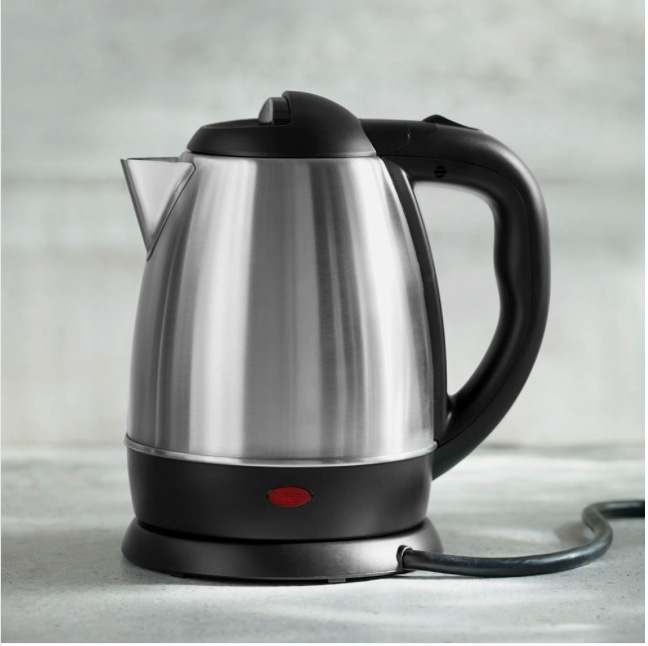
Consider the electric kettle shown in the picture. There is 1 kg of water in the kettle (4 cups of water). This electric kettle transfers energy to the water by heating. The rate of energy transfer is 1000 J/s. The specific heat capacity of water is 4.2 J/(g.K). Calculate the rate that the water temperature rises. Give your answer in units of kelvin/s.
Note: This is an exercise in proportional reasoning. You should not need to look up any formulas.
Sense-making: Put it in context---At this rate, how long would it take to heat up a kettle for making tea? Does this seem like a realistic number?We want to know long it takes a tea kettle to boil. When there are 4 cups of water (about 1000 g of water) the heat capacity of this amount of water is 4200 J/K. The inverse of this quantity is \begin{align} \text{temperature change per energy} = \left(\frac{1}{4200}\frac{\text{K}}{\text{J}}\right). \end{align} We are adding heat at a rate of 1000 J/s, therefore the rate of temperature change is \begin{align} \text{rate of \(T\) change} &= \left(1000\frac{\text{J}}{\text{s}}\right) \left(\frac{1}{4200}\frac{\text{K}}{\text{J}}\right) \\ &= 0.24 \frac{\text{K}}{\text{s}} \\ &\approx 14 \frac{\text{K}}{\text{minute}}. \end{align}
To heat the water to boiling, it will need to rise from 20\(^\circ\)C to 100\(^\circ\)C, which is a temperature change of 80 K, since a Kelvin has the same size as a \(^\circ\)C. So the amount of time required to boil water will be \begin{align} \text{time to boil} &= 80\text{ K} \div \left(14 \frac{\text{K}}{\text{minute}}\right) \\ &\approx 5.5 \text{ minutes} \end{align} I usually forget about my hot water by the time it's boiling, so we can conclude that my attention span is less than five or six minutes, which sounds about right.
- Multiplicity of an ideal gas
S1 5084S
- (T3M.7) The multiplicity of an ideal monatomic gas with \(N\) atoms, internal energy \(U\), and volume \(V\) turns out to be roughly
\begin{align}
\Omega (U, V, N) = CV^NU^{\left(\frac{3 N}{2}\right)}
\end{align}
where \(C\) is a constant that depends on \(N\) alone. Use this expression, together with the fundamental definition of temperature, and they fundamental definition of entropy, to find \(U\) as a function of \(N\) and \(T\) for an ideal gas.
Based on \(\Omega\) for an ideal gas, find the relationship between \(U\) and \(T\). From class we know \(S = k_\text{B} \ln \Omega\). Additionally, if we hold the volume of the gas constant, \(dS/dU = 1/T\). Therefore, \begin{align} \frac{1}{T} &= k_\text{B} \frac{d}{d U} \ln \left(C V^N U^{3N/2}\right)\\ &= k_\text{B} \frac{d}{d U} \left[\ln C + N \ln V + \frac{3 N}{2} \ln U\right]\\ &= k_\text{B} \frac{3 N}{2}\frac{1}{U} \end{align} So, rearranging the equation, \(U = \frac{3}{2} N k_\text{B} T\).
- (From the GRE PhysicsSubject GR0177, given in 2001)
Note 1: The irreversibility of this process tells you that entropy must go (up or down?).
Note 2: The gas constant, \(R\), is equal to Avagadro's number times \(k_B\). Since the process is irreversible, the total change in entropy (for the whole system) must be positive. This eliminates option (D) and (E) in the multiple choice question.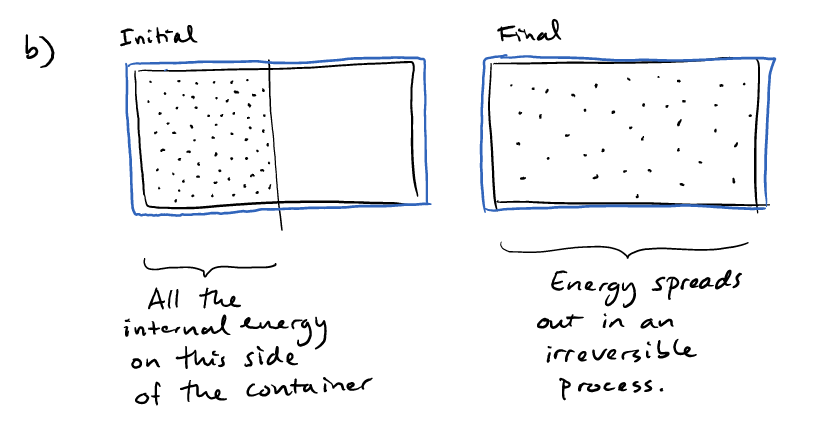
I cannot describe this process as a simple “flow of heat between objects”, so I cannot use the relationship \(\Delta S = Q/T\).
The volume doubles while \(N\) and \(U\) stay constant (there is no change in the internal energy of the gas). I'll put these quantitative statements into the expression for total entropy of a monatomic ideal gas. \begin{align} S_\text{initial} = k_\text{B} \ln\left(C V^N U^{3N/s}\right) \quad \quad \quad S_\text{final} = k_\text{B} \ln\left(C (2V)^N U^{3N/s}\right)\\ \frac{\Delta S}{k_\text{B}} = \ln C + N \ln (2V) + \frac{3N}{2} \ln U - \ln C - N \ln V - \frac{3 N}{2} \ln U \end{align} \begin{align} \Delta S &= k_\text{B} N \left(\ln(2V) - \ln V\right)\\ &= k_\text{B} N \ln 2 \end{align} This is option (B) in the GRE question.
- (T3M.7) The multiplicity of an ideal monatomic gas with \(N\) atoms, internal energy \(U\), and volume \(V\) turns out to be roughly
\begin{align}
\Omega (U, V, N) = CV^NU^{\left(\frac{3 N}{2}\right)}
\end{align}
where \(C\) is a constant that depends on \(N\) alone. Use this expression, together with the fundamental definition of temperature, and they fundamental definition of entropy, to find \(U\) as a function of \(N\) and \(T\) for an ideal gas.
- Thermal energy in the earth's atmosphere
S1 5084S
Thermal energy is stored in all materials on Earth, including the air, water and rocks. The air is composed mostly of diatomic molecules such as N\(_2\) and O\(_2\).
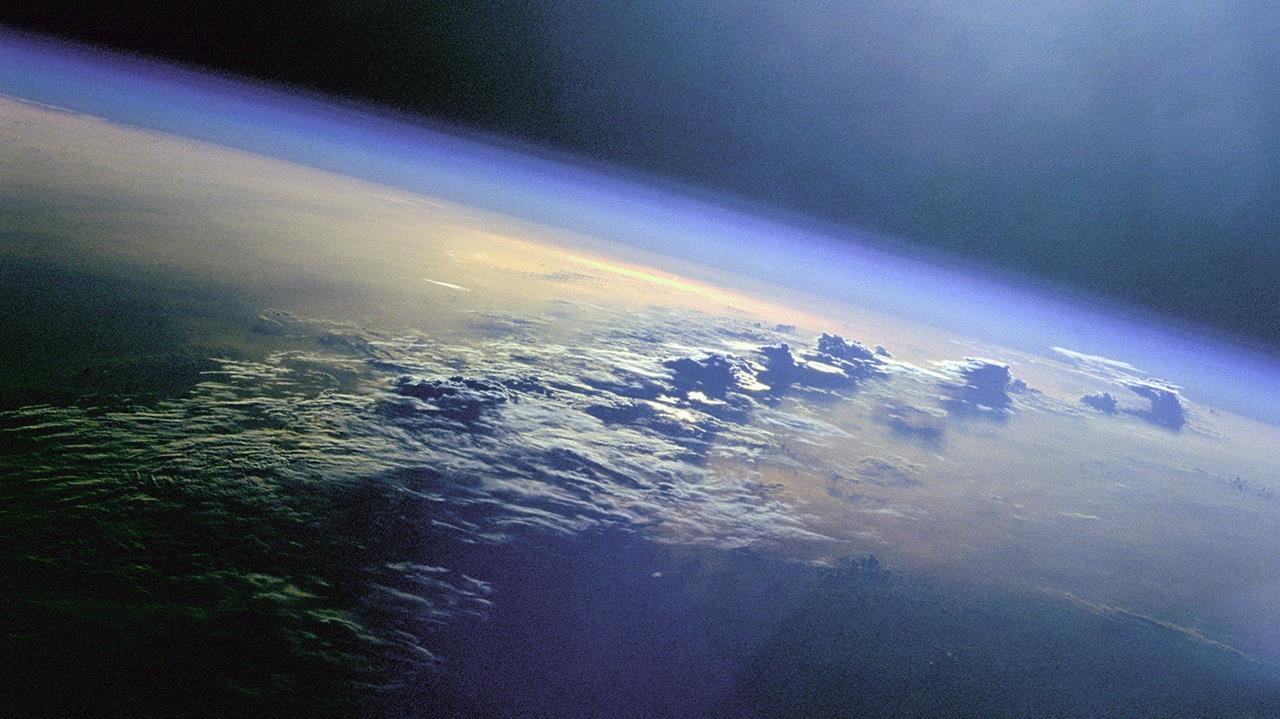
Use Google to look up the mass of the earth's atmosphere. Now, exercise some skepticism and make sure that Goggle's answer is consistent with other facts about the earth: Air pressure at sea level is about 100 kPa and the radius of the earth is about 6400 km. The air pressure at sea level (force per unit area) is caused by the downward force of gravity acting on the atmosphere directly above a unit area. The thickness of the atmosphere is much much less than the radius of the earth. Give your argument supporting or refuting the internet's value for the mass of the earth's atmosphere.
Google says the mass of the Earth's atmosphere is \(5\times10^{18}\) kg. I want to check this. First, consider a column of air.
Every square meter of earth's surface has 10,000 kg of air directly above it. Radius of the Earth is \(\approx\) 6400 km. \begin{align} m_\text{atm} &= \left(4 \pi r_\text{earth}^2\right)(m_\text{sqr})\\ &= 4 \pi (6.4\times10^6 \text{ m})^2 (10^4 \text{ kg/m}^2) \\ &= 5\times 10^{18} \text{ kg} \end{align}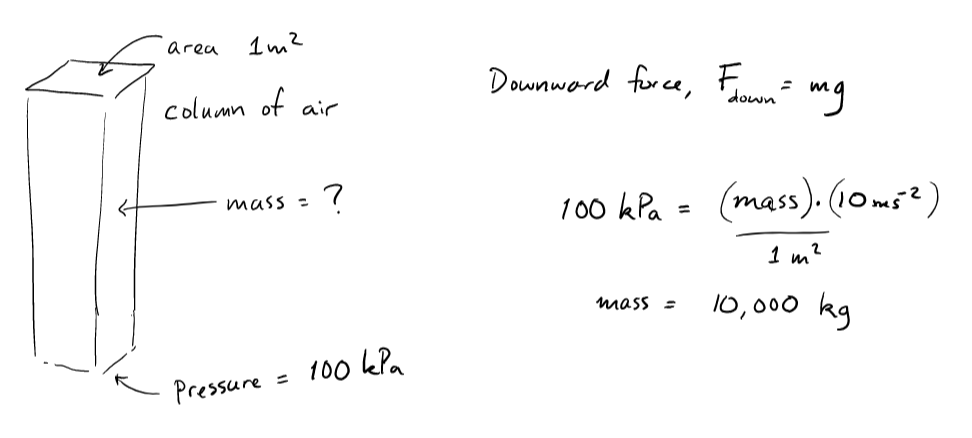
We know that between 1955 and 2010, the temperature of the top 2000 meters of the ocean rose by about 0.05 C. Given this fact, assess the validity of the following statement:
“If the same amount of heat that has gone into the top 2000 meters of the ocean between 1955-2010 had gone into the lower 10 km of the atmosphere, then the atmosphere would have warmed by about 20\(^\circ\)C (36\(^\circ\)F).”
Is this statement reasonable, or ridiculous? Show your calculations that support your conclusion. Your starting assumptions will include the specific heat capacity of air and water at constant pressure, and a reasonable guess regarding the fraction of the earth's surface that is covered with ocean.
I need to calculate the mass of water in top 2000 m of ocean. \begin{align} \text{Surface area of earth} &= 4 \pi R_\text{earth}^2\\ &=4 \pi (6.4\times10^{6})^2\\ &= 5.14\times10^{14} \text{ m}^2\\ \\ \text{Volume of water} &= \left(\frac{2}{3}\right)(5\times10^{14})(2\times10^3) \text{ m}^3\\ &\text{The 2/3 is because 2/3 of the planet is ocean}\\ &= 7\times10^{17}\text{ m}^3\\ \\ \text{Mass of water} &= (10^3 \text{ kg/m}^3)(7\times10^{17} \text{ m}^3) = 7\times10^{20} \text{ kg} \end{align} Now we can find the heat required to raise the ocean temperature by 0.05\(^\circ\) C. \begin{align} Q &= m c_\text{p,water} \Delta T \\ &= [7\times10^{20} \text{ kg}][4.2 \text{ kJ}\cdot\text{kg}^{-1}\cdot\text{K}^{-1}][5\times10^{-2} \text{ K}]\\ &= 10^{20}\text{ kJ} \end{align} Heat required to raise air temperature by 20\(^\circ\)C. \begin{align} Q &= m c_\text{p,air} \Delta T \\ &= (5\times10^{18} \text{ kg})(1 \text{ kJ}\cdot\text{kg}^{-1}\cdot\text{K}^{-1})(20 \text{ K})\\ &= 10^{20}\text{ kJ} \end{align}
Note that I've used the heat capacity of air at constant pressure (\(c_\text{p,air} \approx 1 \text{ kJ}\cdot\text{kg}^{-1}\cdot\text{K}^{-1}\)), which is greater than the heat capacity of air at constant volume (\(c_\text{v,air} \approx 0.7 \text{ kJ}\cdot\text{kg}^{-1}\cdot\text{K}^{-1}\)). The reason for this difference is the following. If we heat a gas while keeping the pressure of the gas constant, then some heat energy must be turned into work - expanding the volume of the gas. Thus, less heat energy goes into raising the internal energy of the gas.
When answering this question, \(c_\text{p,air}\) is the correct choice. I won't dock points if you used \(c_\text{v,air}\). For example, if you estimated the heat capacity of air using the equipartition theorem, you should have found a reasonable value for \(c_\text{v,air}\).
The statement appears to be true, the same amount of heat is required to either raise the ocean temp by 0.05\(^\circ\)C or to raise the air temp by 20\(^\circ\)C.
- Entropy Basics
S1 5084S
- (T3B.5) Objects A and B have different temperatures and initial entropies of 22 J/K and 47 J/K. We bring the objects into thermal contact and allow them to come to equilibrium (the objects are isolated from everything else). What is the most quantitative statement that we can make about the combined system's entropy after the two objects come to equilibrium?
After the two objects with different temperatures have exchanged energy the system can be described using the following equation. \begin{align} S_{\text{A}} + S_{\text{B}} > 69 \text{ J/K} \end{align}
- (T3B.8) Suppose that we increase an object's internal energy 10 J by heating the object. The temperature of the object remains roughly constant at 20 C. By how much does the object's entropy increase?
When the temperature of the object is approximately constant, then \begin{align} \Delta S &= \frac{Q}{T}\\ &= \frac{10 \text{ J}}{293 \text{ K}} = 0.03 \text{ J/K} \end{align}
- (T3B.5) Objects A and B have different temperatures and initial entropies of 22 J/K and 47 J/K. We bring the objects into thermal contact and allow them to come to equilibrium (the objects are isolated from everything else). What is the most quantitative statement that we can make about the combined system's entropy after the two objects come to equilibrium?