Contemporary Challenges: Fall-2024
Homework 2 (SOLUTION): Due 8 Friday 10/11
- Gasoline Sun
S1 5083S
Electromagnetic radiation energy from the Sun arrives at the upper atmosphere of our planet at a rate of about 1350 J/(s \(\cdot\) m\(^2\)). Use this information, together with the average radius of the Earth's orbit, to show that the Sun radiates energy at a rate of about \(4 \times 10^{26}\) J/s.
We want to know the rate that energy radiates from the Sun. At a distance of \(1.5 \times 10^{11}\) m, the energy arrives at a rate of \(1350\) J/(s \(\cdot\) m\(^2\)). By conservation of energy, the rate that at which the energy leaves the sun, must also equal the rate at which it passes through the sphere at radius \(r\) from the sun. Using that the Area of a sphere is \(4\pi r_{\text{orbit}}^2\), we can find the energy per time.
\begin{align} \frac{\text{Energy}}{\text{time}} &= (1350 \text{ J/s.m\(^2\)} )(4 \pi (1.5 \times 10^{11} \text{ m})^2) \\ &= 4 \times 10^{26} \text{ J/s} \end{align}
We know from radiometric dating of rocks on Earth (and the Moon and Mars) that our solar system is about 4 billion years old. Let's make a naïve hypothesis (like scientists did in the early 1900s) that the Sun is powered by burning hydrocarbons. What mass of gasoline would be needed to power the Sun at a rate of \(4 \times 10^{26}\) J/s for 4 billion years? Compare to the actual mass of the Sun.
Note: The energy density of hydrocarbon fuels, including gasoline, natural gas, dry logs of wood, chocolate, croissants, gummy bears, etc. etc. is \(\approx\) 40 MJ/kg.
Total energy emitted as light during the 4 billion year lifetime: \begin{align} E_{\text{light}} &= (4 \times 10^{26} \text{ J/s})(3\times 10^7 \text{ s/y})(4\times 10^9 \text{ y}) \\ &= 50\times10^{42} \text{ J} = 50\times10^{36} \text{ MJ} \end{align} How much gasoline would it take to produce this energy? \begin{align} m_{\text{gasoline}} = \frac{50\times10^{36}\text{ MJ}}{40 \text{ MJ/kg}} = 1.25\times10^{36} \text{ kg} \end{align} We can compare this to the mass of the sun, \(M_{\text{sun}} = 2\times 10^{30}\) kg. The sun would have to be almost 1 million times more massive if it was running on hydrocarbon fuels.
- Hot showers and standard deviation
S1 5083S
(a) Estimate the energy used during a typical 10-minute shower in the United States. The dominant variables in this problem are the temperature rise of the water and the flow rate of the showerhead. Develop a coarse-grained model that incorporates these two variables. For simplicity, you may assume: (i) The water heater is 100% efficient at converting electrical energy into heat, and (ii) the water heater is located close to the shower, so heat losses in the pipes can be neglected.

(b) Develop a reasonable estimate for the standard deviation of your answer to part a. That is, imagine measuring the energy used for a 10-minute shower in a thousand randomly selected U.S. households. How much would the energy use vary? To develop a reasonable estimate, spend a little time doing internet research (or in-person research) on the variability of shower flow rates, the variability of ground temperature, and the variability of shower water temperature (personal preference). Once you can justify reasonable numbers for the variability of these inputs, propogate the uncertainty through your coarse-grained model using the methods we discussed in class.
(c) Sense making: Compare the typical energy used for a 10-minute shower to the typical energy used to drive an elecric car at 70 mph for 10 minutes.
Shower
The flow rate of a shower can vary significantly. The average flow rate is about 2 gal/min, but you can easily find showers using 1.5 gal/min to 2.5 gal/min. The standard deviation is about 0.5 gal/min (this is estimate).
The average 10-minute shower uses 20 gallon of water, which has a mass \(m\) = 80 kg, the standard deviation in water mass is \(\sigma_m=\) 20 kg. Therefore \(\sigma_m/m=\) 25%)
The water must be heated from ground temperature (pipes are buried in the ground where the temperature is about 12 C) to comfortable shower temperature (body temperature is 38 C, water burns skin at 50 C). Most people like the temperature in the range 38 - 42 C. Let's say the average value of \(\Delta T\) = 28 C, and the standard deviation is about 2 C. Therefore, \(\sigma_{\Delta T}/\Delta T=\) 10%)
The heat required is then \(Q = m c \Delta T\), where \(c = 4200\) J/(K.kg) and \(m\) is the mass of the water. \begin{align} Q_\text{avg} &= (80 \text{ kg})(4.2\times10^3 \text{ J/(K.kg)})(28 \text{ K}) = 10 \text{ MJ} \end{align}
Using pythagorium addition of the percentage uncertainties I get a final uncertainty of 27%. My final answer for a 10-minute shower in then \begin{align} Q &= 10 \pm 3\text{ MJ} \end{align}
If I refined my coarse-grained model, I could include the energy required to pump this water up a hill. For a hill of 100 m, let's compare the change in gravitational potential energy to the heat energy: \begin{align} \frac{PE}{Q} = \frac{m g h}{m c \Delta T} = \frac{(10\text{ m/s})(100\text{ m})}{(4200\text{ J/(K kg)})(30\text{ K})} = \frac{10^3}{126\times10^3} = \frac{1}{126} \end{align} For a hill of 100 m, the gravitational potential energy cost is less than \(1\%\) of the heat energy.
Car
In the class notes we estimated 20,000 J/s. Driving the car for 10 minutes would use \begin{align} \text{Energy used } = (2 \times 10^4 \text{ J/s})(6 \times 10^2 \text{ s}) \approx 10 \text{ MJ} \end{align}
The rate that we use electrical energy to heat shower water is very similiar to the rate that we use electrical energy to drive a car at 70 mph.
- Heat loss from a single-family home in winter
S1 5083S
Consider a family home that has a floor area of 50 feet \(\times\) 50 feet, and a ceiling height of 10 feet. The house has typical the insulation for the Pacific Northwest: R-15 walls and an R-30 ceiling.
To help you with physics reasoning, I have converted the R-values into standard-international (SI) units for heat conductance per unit area: \begin{align} \text{wall conductance per unit area} &= 0.4\text{ }\frac{\text{W}}{\text{K}\text{.m}^2}\\ \text{ceiling conductance per unit area} &= 0.2\text{ }\frac{\text{W}}{\text{K}\text{.m}^2} \end{align} Based on the units listed above, and the context (thermal insulation), you can visualize the meaning of these proportionality constants. For example, if there is a 1 kelvin temperature difference between inside/outside the house, every square meter of wall will leak energy at a rate of 0.4 J/s. Doubling the temperature difference, or doubling the wall area, will double the leak rate.
If the indoor temperature is 293 K (68\(^\circ\)F), and the outdoor temperature is 273 K (32\(^\circ\)F), how fast does heat energy leak out of the house (joules/second)? For this question, please assume the floor is perfectly insulated so that no heat leaks out of the floor.
Sense making 1: Three of the most significant categories of human energy use in the United States are (1) the embodied energy of the stuff we buy \(\approx\) 170 MJ/day per person, (2) the energy used driving cars \(\approx\) 140 MJ/day per person, (3) the energy used by jet flights \(\approx\) 100 MJ/day per person (all these energy rates are averaged over the course of a year). How does the heat loss from a family home compare to the other categories on this list?Sense making 2: How many small, portable heaters are needed to heat this house? (assume 1 kW heaters). Does this seem like a realistic number of heaters?
We want to estimate how much thermal energy is leaking out of a typical house during the winter months. We assume that the temperature difference between inside/outside is 20 K. I need to know the area of the walls and ceiling. \begin{align} A_{\text{walls}} &= 2000\text{ ft}^2 \approx 200\text{ m}^2 \\ A_{\text{ceiling}} &= 2500\text{ ft}^2 \approx 250\text{ m}^2 \end{align} Now, multiplying these areas by the heat conductivity and the temperature difference \begin{align} P_{\text{walls}} &= \left(0.5\frac{1}{\text{s}\cdot\text{m}^2\cdot\text{K}}\right) \cdot \left(200\text{ m}^2\right)\cdot 20\text{ K} \\ &= 1600\frac{\text{J}}{\text{s}} \\ P_{\text{ceiling}} &= \left(0.2\frac{1}{\text{s}\cdot\text{m}^2\cdot\text{K}}\right) \cdot \left(250\text{ m}^2\right)\cdot 20\text{ K} \\ &= 1000\frac{\text{J}}{\text{s}} \\ P_{\text{total}} &= 2600\frac{\text{J}}{\text{s}} \end{align}
To keep this house at a steady temperature, you'd need three electric heters, each emitting thermal energy at a rate of 1000 J/s.
This seems small to me. My furnace broke down during the winter a few years back, and we borrowed probably six or seven space heaters to keep the house liveable. My guess is that the issue is our windows. Single-pane windows have an R-value of about R-1, which means that if any of our windows are single-pane (and it's a house from the 70's), we could get \begin{align} P_{\text{window}} &= \left(6\frac{1}{\text{s}\cdot\text{m}^2\cdot\text{K}}\right) \cdot \left(2\text{ m}^2\right)\cdot 20\text{ K} \\ &= 240\frac{\text{J}}{\text{s}} \end{align} So four windows could contribute as much as my ceiling. Better windows have an R-value of more like 4 or 5, but I've got a lot of windows. Also, I didn't have proper weather stripping under the door. So I think our estimate is reasonable, but neglects some contributions that may be important.
The other interesting way to examine this to convert it into electrical cost. Electricity in Oregon in 2021 costs 11 cents per kWh. So the cost of the energy loss through walls and ceilings is \begin{align} \text{cost} &= 2600\frac{\text{J}}{\text{s}}\cdot \left(0.11\frac{\$\cdot\text{s}}{\text{kJ}\cdot\text{hour}}\right) \cdot\left(\frac{1\text{ kJ}}{10^3\text{ J}}\right) \\ &= 0.3 \frac{\$}{\text{hour}} \cdot\left(\frac{24\text{ hours}}{\text{day}}\right) \cdot\left(\frac{30\text{ days}}{\text{month}}\right) \\ &= \$200/\text{month} \end{align} Now that sounds about right actually. I now have a heat pump, so I pay much less than this, but in the dead of winter I was paying about this much before we installed the heat pump, when we had a regular electric furnace.
- Tea kettle
S1 5083S
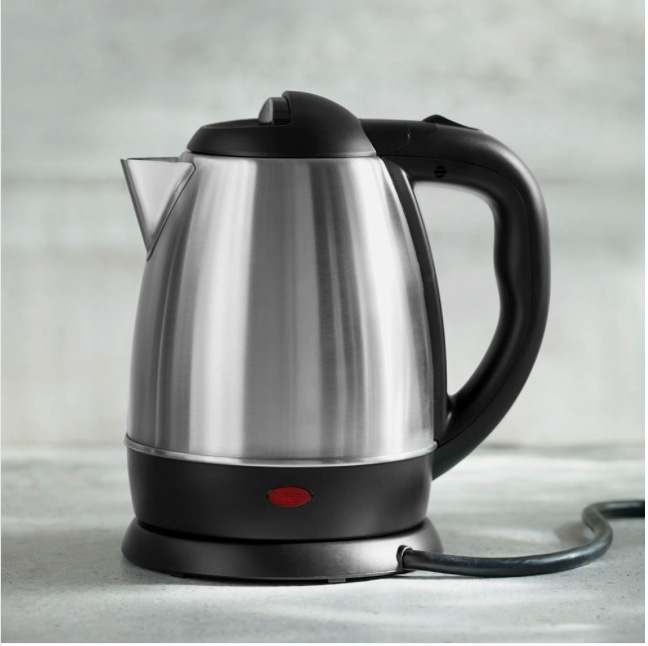
Consider the electric kettle shown in the picture. There is 1 kg of water in the kettle (4 cups of water). This electric kettle transfers energy to the water by heating. The rate of energy transfer is 1000 J/s. The specific heat capacity of water is 4.2 J/(g.K). Calculate the rate that the water temperature rises. Give your answer in units of kelvin/s.
Note: This is an exercise in proportional reasoning. You should not need to look up any formulas.
Sense-making: Put it in context---At this rate, how long would it take to heat up a kettle for making tea? Does this seem like a realistic number?We want to know long it takes a tea kettle to boil. When there are 4 cups of water (about 1000 g of water) the heat capacity of this amount of water is 4200 J/K. The inverse of this quantity is \begin{align} \text{temperature change per energy} = \left(\frac{1}{4200}\frac{\text{K}}{\text{J}}\right). \end{align} We are adding heat at a rate of 1000 J/s, therefore the rate of temperature change is \begin{align} \text{rate of \(T\) change} &= \left(1000\frac{\text{J}}{\text{s}}\right) \left(\frac{1}{4200}\frac{\text{K}}{\text{J}}\right) \\ &= 0.24 \frac{\text{K}}{\text{s}} \\ &\approx 14 \frac{\text{K}}{\text{minute}}. \end{align}
To heat the water to boiling, it will need to rise from 20\(^\circ\)C to 100\(^\circ\)C, which is a temperature change of 80 K, since a Kelvin has the same size as a \(^\circ\)C. So the amount of time required to boil water will be \begin{align} \text{time to boil} &= 80\text{ K} \div \left(14 \frac{\text{K}}{\text{minute}}\right) \\ &\approx 5.5 \text{ minutes} \end{align} I usually forget about my hot water by the time it's boiling, so we can conclude that my attention span is less than five or six minutes, which sounds about right.