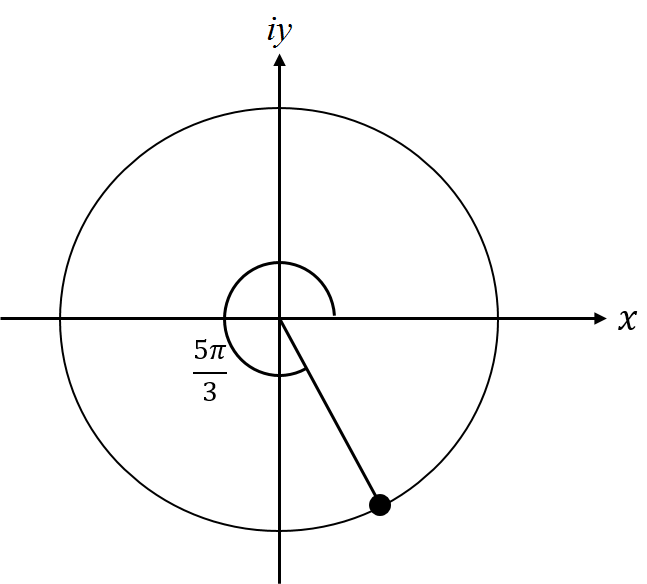
Find the rectangular coordinates of the point where the angle \(\frac{5\pi}{3}\) meets the unit circle. If this were a point in the complex plane, what would be the rectangular and exponential forms of the complex number? (See figure.)
Students move their left arm in a circle to trace out the complex plane (Argand diagram). They then explore the rectangular and exponential representations of complex numbers by using their left arm to show given complex numbers on the complex plane. Finally they enact multiplication of complex numbers in exponential form and complex conjugation.
(Algebra involving trigonometric functions) Purpose: Practice with polar equations.
The general equation for a straight line in polar coordinates is
given by:
\begin{equation}
r(\phi)=\frac{r_0}{\cos(\phi-\delta)}
\end{equation}
where \(r_0\) and \(\delta\) are constant parameters. Find the polar equation for the straight lines below. You do NOT need to evaluate any complicated trig or inverse trig functions. You may want to try plotting the general polar equation to figure out the roles of the parameters.
For an infinitesimally thin cylindrical shell of radius \(b\) with uniform surface
charge density \(\sigma\), the electric field is zero for \(s<b\) and \(\vec{E}=
\frac{\sigma b}{\epsilon_0 s}\, \hat s\) for \(s > b\). Use the differential form
of Gauss' Law to find the charge density everywhere in space.
Found in: Static Fields, AIMS Maxwell, Problem-Solving course(s)
This small group activity using surfaces combines practice with the multivariable chain rule while emphasizing numerical representations of derivatives.
Students work in small groups to measure partial derivatives in both rectangular and polar coordinates, then verify their results using the chain rule.
The whole class wrap-up discussion emphasizes the relationship between a directional derivative in the \(r\)-direction and derivatives in \(x\)- and \(y\)-directions using the chain rule.
In this small group activity, students draw components of a vector in Cartesian and polar bases. Students then write the components of the vector in these bases as both dot products with unit vectors and as bra/kets with basis bras.
Students observe three different plots of linear combinations of spherical combinations with probability density represented by color on the sphere, distance from the origin (polar plot), and distance from the surface of the sphere.
to perform a magnetic vector potential calculation using the superposition principle;
to decide which form of the superposition principle to use, depending on the dimensions of the current density;
how to find current from total charge \(Q\), period \(T\), and the geometry of the problem, radius \(R\);
to write the distance formula \(\vec{r}-\vec{r'}\) in both the numerator and denominator of the superposition principle in an appropriate mix of cylindrical coordinates and rectangular basis vectors;
Students calculate two different (thermodynamic) partial derivatives of the form \(\left(\frac{\partial A}{\partial B}\right)_C\) from information given on the same contour map.
Found in: Surfaces/Bridge Workshop, None course(s)
This small group activity is designed to provide practice with the chain rule and to develop familiarity with polar coordinates.
Students work in small groups to relate partial derivatives in rectangular and polar coordinates.
The whole class wrap-up discussion emphasizes the importance of specifying what quantities are being held constant.