Students consider the relation (1) between the angular momentum and magnetic moment for a current loop and (2) the force on a magnetic moment in an inhomogeneous magnetic field. Students make a (classical) prediction of the outcome of a Stern-Gerlach experiment.
to perform a magnetic vector potential calculation using the superposition principle;
to decide which form of the superposition principle to use, depending on the dimensions of the current density;
how to find current from total charge \(Q\), period \(T\), and the geometry of the problem, radius \(R\);
to write the distance formula \(\vec{r}-\vec{r'}\) in both the numerator and denominator of the superposition principle in an appropriate mix of cylindrical coordinates and rectangular basis vectors;
Students work in small groups to use the Biot-Savart law
\[\vec{B}(\vec{r}) =\frac{\mu_0}{4\pi}\int\frac{\vec{J}(\vec{r}^{\,\prime})\times \left(\vec{r}-\vec{r}^{\,\prime}\right)}{\vert \vec{r}-\vec{r}^{\,\prime}\vert^3} \, d\tau^{\prime}\]
to find an integral expression for the magnetic field, \(\vec{B}(\vec{r})\), due to a spinning ring of charge.
In an optional extension, students find a series expansion for \(\vec{B}(\vec{r})\) either on the axis or in the plane of the ring, for either small or large values of the relevant geometric variable.
Add an extra half hour or more to the time estimate for the optional extension.
Consider a paramagnet, which is a
material with \(n\) spins per unit volume each of which may each be
either “up” or “down”. The spins have energy \(\pm mB\) where
\(m\) is the magnetic dipole moment of a single spin, and there is no
interaction between spins. The magnetization \(M\) is defined as the
total magnetic moment divided by the total volume. Hint: each
individual spin may be treated as a two-state system, which you have
already worked with above.
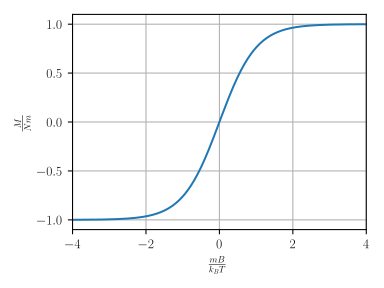
Plot of magnetization vs. B field
Find the Helmholtz free energy of a paramagnetic system (assume
\(N\) total spins) and show that \(\frac{F}{NkT}\) is a function of
only the ratio \(x\equiv \frac{mB}{kT}\).
Use the canonical ensemble (i.e. partition function and
probabilities) to find an exact expression for the total
magentization \(M\) (which is the total dipole moment per unit
volume) and the susceptibility \begin{align}
\chi\equiv\left(\frac{\partial M}{\partial
B}\right)_T
\end{align} as a function of temperature and magnetic field for the
model system of magnetic moments in a magnetic field. The result for
the magnetization is \begin{align}
M=nm\tanh\left(\frac{mB}{kT}\right)
\end{align} where \(n\) is the number of spins per unit volume. The figure shows what this magnetization looks like.
Show that the susceptibility is \(\chi=\frac{nm^2}{kT}\) in the
limit \(mB\ll kT\).
Students, pretending they are point charges, move around the room so as to make an imaginary magnetic field meter register a constant magnetic field, introducing the concept of steady current. Students act out linear \(\vec{I}\), surface \(\vec{K}\), and volume \(\vec{J}\) current densities. The instructor demonstrates what it means to measure these quantities by counting how many students pass through a gate.
Nuclei of a particular isotope species contained in a crystal have
spin \(I=1\), and thus, \(m = \{+1,0,-1\}\). The interaction between
the nuclear quadrupole moment and the gradient of the crystalline
electric field produces a situation where the nucleus has the same
energy, \(E=\varepsilon\), in the state \(m=+1\) and the state \(m=-1\),
compared with an energy \(E=0\) in the state \(m=0\), i.e. each nucleus
can be in one of 3 states, two of which have energy \(E=\varepsilon\)
and one has energy \(E=0\).
Find the Helmholtz free energy \(F = U-TS\) for a crystal
containing \(N\) nuclei which do not interact with each other.
Find an expression for the entropy as a function of
temperature for this system. (Hint: use results of part a.)
Indicate what your results predict for the entropy at the
extremes of very high temperature and very low temperature.