Oscillations and Waves: Spring-2025
HW 5a: Due W5 D2
- Reflection and Transmission at a Sharp Boundary
A traveling wave in a string is incident from the left (L) and propagates at speed \(v_1\), encountering a second string at \(x=0\). It partially reflects, returning in the same string with speed \(v_1\). It partially continues into a second string, traveling with speed \(v_2\).
\begin{equation*}
\psi(x,t)=
\begin{cases}
\psi_L(x,t)=Re[Ae^{i(-\omega_1 t+k_1 x)}]+Re[Be^{i(-\omega_1 t-k_1 x)}]\,&\text{ for }x\leq0\\
\psi_R(x,t)=Re[Ce^{i(-\omega_2 t+k_2 x)}] &\text{ for }x\geq0
\end{cases}
\end{equation*}
Explain the meanings of the terms in the wavefunctions and say which directions the waves propagate.
Explain why \(\omega_1=\omega_2=\omega\)
What equation represents the statement, “The string must be continuous at the boundary”? Show that it leads to \(A+B=C\).
Write the piecewise function for \(\frac{\partial\psi(x,t)}{\partial x}\).
What equation represents the statement, “The transverse component of the force at the boundary must sum to zero”? Show that it leads to \(k_1A-k_1B=k_2C\)
Solve the equations in (c) and (e) and find the displacement reflection and transmission coefficients \(R_\psi\equiv\frac{B}{A}=\frac{k_1-k_2}{k_1+k_2}\) and \(T_\psi\equiv\frac{C}{A}=\frac{2k_1}{k_1+k_2}\).
Look carefully at the expression in (d) and show that you can define a reflection coefficient for \(\frac{\partial\psi}{\partial x}\) and that it is \(R_{\frac{\partial\psi}{\partial x}}=\frac{k_2-k_1}{k_1+k_2}\)
- Look carefully at the expression in (d) and show that you can define a transmission coefficient for \(\frac{\partial\psi}{\partial x}\) and that it is \(T_{\frac{\partial\psi}{\partial x}}=\frac{2k_2}{k_1+k_2}\)
- Light Propagation in a Vacuum Light propagates in vacuum with speed \(c\) and in a medium with speed \(v = \frac{c}{n}\) where \(n\) is the refractive index (\(n>1\)). (The refractive index is not an integer!) Show that when light is incident from vacuum (\(n=1\)) onto glass (\(n=1.5\)), about 4% of the energy (which is proportional to \(|\psi|^2\) is reflected. Also show that the light changes its phase angle by \(\pi\) when it is reflected.
- Square Wave in a Rope
A rectangular traveling pulse is launched with speed \(v_1\) from the left into a very long rope. At the boundary at \(x=0\), the pulse is partially reflected and partially transmitted into a second rope where the transmitted pulse moves with velocity \(v_2\). The reflected (black) and transmitted (red) pulses are depicted some time after the original pulse encounters the boundary. The system obeys the NDWE.
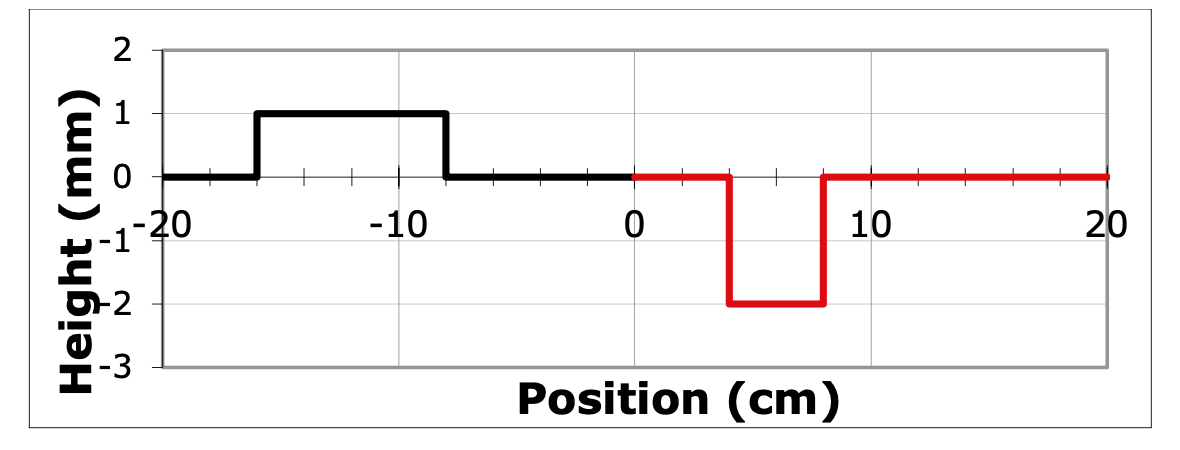 Figure: A point in time of the graph of a square wave after reflecting and transmitting at \(x=0\).
Use the widths of the reflected and transmitted pulses to find the ratio of \(v_1\) to \(v_2\). Explain.
Calculate the relative velocities using the pulse locations and show that this is consistent with (a).
Is the mass density of the red rope smaller or larger than the black rope? Why?
Describe the original pulse (height, polarity, length), showing qualitative and quantitative reasoning.
- Can you determine the velocities \(v_1\) and \(v_2\)? If so, what are they, and if not, what information would you need?