Oscillations and Waves: Spring-2025
HW 3b: Due W3 D5
- LRC Draft Lab Writeup
This homework assignment is entirely geared to guiding you through the lab write-up. Anything assigned here will make an important contribution to your report. Part of the assignment addresses fundamental understanding and parts asks you to reflect on communication.
Circuit Diagram
Create a diagram with caption of the LRC circuit you investigated in Thursday's lab. It does not have to be an original creation, but if it is not, you should acknowledge the source in the caption.
- Create a caption for your figure contains a figure number and an informative but succinct description so that the figure and caption together can stand alone. Use the captions in the McGuyer paper on the canvas website as a model.
- What information would you want in a figure caption to understand the context? Go beyond the obvious “Circuit diagram,” but do not introduce new physics or discussion. That's for the text.
- What features of a caption do you consider important? In the McGuyer paper on the canvas website, state one feature that you think is well done. Anything surprising to you?
Figures showing driving voltage and response
For the three cases \(\omega < \omega_0\), \(\omega = \omega_0\), \(\omega > \omega_0\) generate a figure that illustrates the circuit response relative to the driving voltage. Decide whether one graph or three is best. Provide a good caption for the figure.
Table of raw and processed results
From HW 2b, take the table you generated, and prepare a well-crafted table that has the relevant raw numbers you recorded and the derived quantities.
- Pay attention to significant figures, column headings and units, clarity of presentation.
- Write a caption for the table. Can the reader easily make sense of the table?
This table could appear in the main body of your text, or it could be placed in an appendix.
Graphs of \(|I(\omega_d)|\) and \(\phi_I (\omega_d)\) data and model
Generate a graph of \(|I(\omega_d)|\) (or a quantity proportional to it that you prefer to communicate) as a function of \(\omega_d\) (or \(f_d\) if you prefer that variable) from your measured values. On the same graph, present the prediction from the model we studied in class. Is the model satisfactory? If not, what actions do you suggest?
Repeat for the phase \(\phi_I(\omega_d)\) or \(\phi_I(f_d)\) if you prefer \(f_d\) as a variable.
- How is the model prediction most effectively presented? Lines? Points? Different color?
- Create a caption for these plots. Have you clearly differentiated between the model and the data in the caption?
Draft
Draft your report by creating section headings for all sections of the report. The draft should contain
- the plots and captions you generated in 1-4,
- the paragraphs you drafted in HW2b
and at least a 1-paragraph description of what you plan to put in any section where you don't have any text yet.
This draft then will be polished into a Final Report to turn in on Tuesday of Week 4.
We will try to get feedback to you in a timely fashion.
- LRC Behavior At, Above, and Below Resonance
You should find the Mathlet at https://mathlets.org/mathlets/series-rlc-circuit useful. In fact, the purpose of this question is really to get you to explain that simulation confidently.
A series LRC circuit is driven by a sinusoidal voltage that by convention we write: \[|V_0|\cos{(\omega t)=Re[|V_0|e^{i\omega t}]}\]
Draw phasor diagrams (i.e. on an Argand plot) representing the driving voltage at \(t=0\) and each of the voltages across teh capacitor \(V_C\), resistor \(V_R\), inductor \(V_L\) in a driven \(LRC\) circuit for three different cases: \((1) \,\omega << \omega_0\), \((2)\,\omega=\omega_0\) (resonance frequency), \((3)\,\omega>>\omega_0\). One phasor is filled in for you, with the red arrow representing the phase of the input voltage into the circuit and the blue arrow representing the phase of the voltage across the circuit component. Don't worry too much about the magnitudes of each arrow.
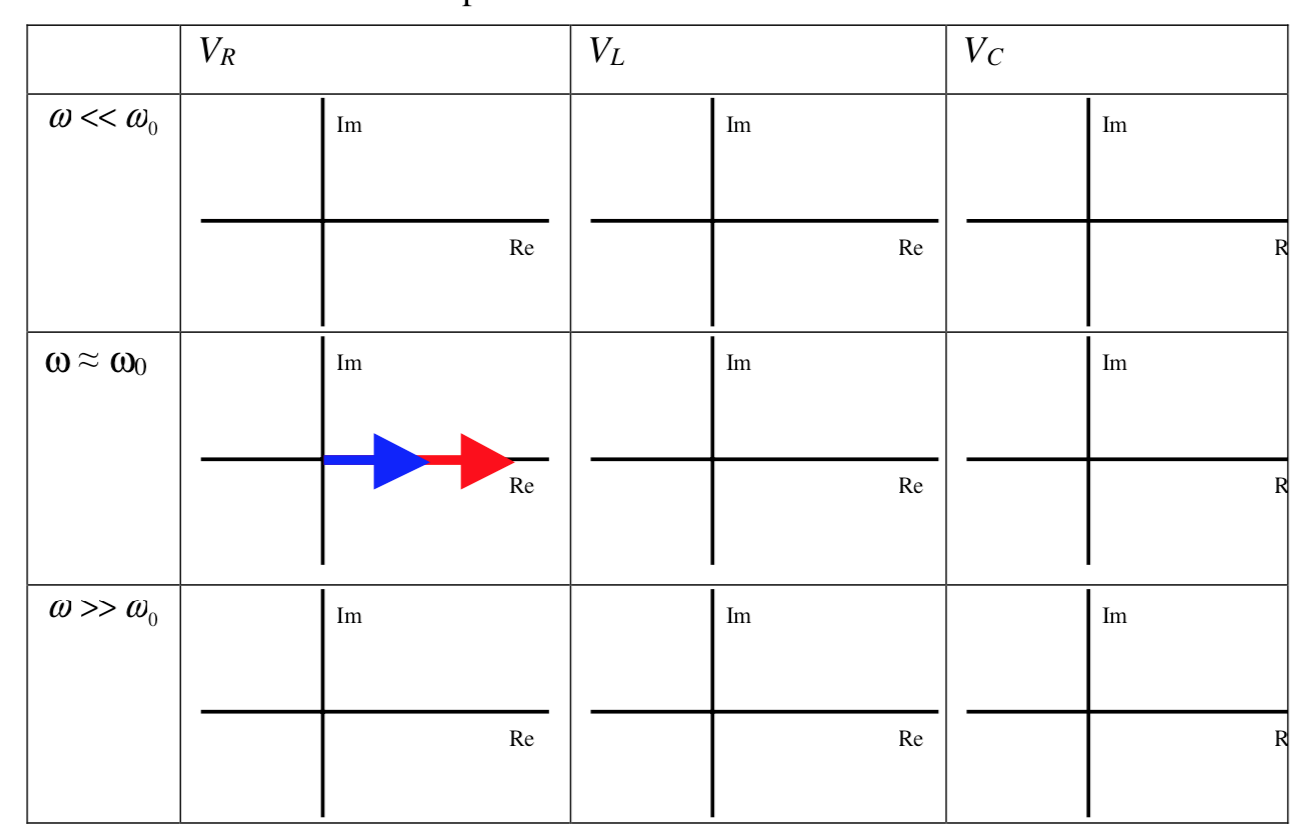
- Can you explain why we say the circuit is predominantly resistive at resonance, predominantly capacitative at low frequencies, and predominately inductive at high frequencies?
- Broadcast Bandwidth FM radio stations have broadcast frequencies of approximately \(100\,MHz\). Assume that your radio uses a series LRC circuit similar to the one you used in the lab as part of the receiver electronics. The quality factor \(Q\) of the receiver circuit determines the spacing of the broadcast frequencies of the stations your receiver pick up without interference from other stations. Estimate the spacing of the broadcast frequencies of FM stations if typical receivers have a \(Q\) of \(500\) or better. Explain your reasoning, and include a graph to illustrate (sketch is OK).