Contemporary Challenges: Fall-2026
Practice Midterm 2 (not to be turned in): Due Week 8 Friday (11/20)
- In-person examination instructions
Write your answers in the space underneath each question. Put your name on every page. You are welcome to use extra paper. Extra paper will be provided (put your name on every page). If writing in pencil, make sure it is dark enough to be scanned.
You may use a single-sided note card of size 8.5” x 11” (letter paper). Use this note card to write down any information you want to access during the exam.
You may use a calculator. Alternatively, full credit will be given if you do arithmetic by hand and make a reasonable effort to get a final answer within \(\pm 20\%\). For example, \(\pi\) can be rounded to \(3\), and \(g\) can be rounded to \(10\text{ m/s}^2\).
One goal of this course is that you become comfortable choosing a reasonable value for a quantity. Therefore, the questions won't tell you every quantity. If you get stuck because you cannot choose a reasonable value, please ask. The instructor will tell you the quantity, and make a small reduction in the points available for that question.
The course instructor will also be available to answer clarifying questions during the exam. State any assumptions you make to solve the problem. Show the mathematics that you use to solve the problem. Show units when working with the numerical values of physical quantities. Because time is limited, you are not required/expected to write very many words explaining your reasoning. However, using words to explain your reasoning can allow the grader to distinguish small mistakes from big ones.
Very big or very small numbers must be expressed in scientific notation (for example, \(1.2\times 10^6\)). You will lose points if you use decimal notation to express numbers that are greater than \(10^6\) or less than \(10^{-3}\). You will also lose points if you use E-notation (for example, do not write 1.2E6).
- Andasol power plant
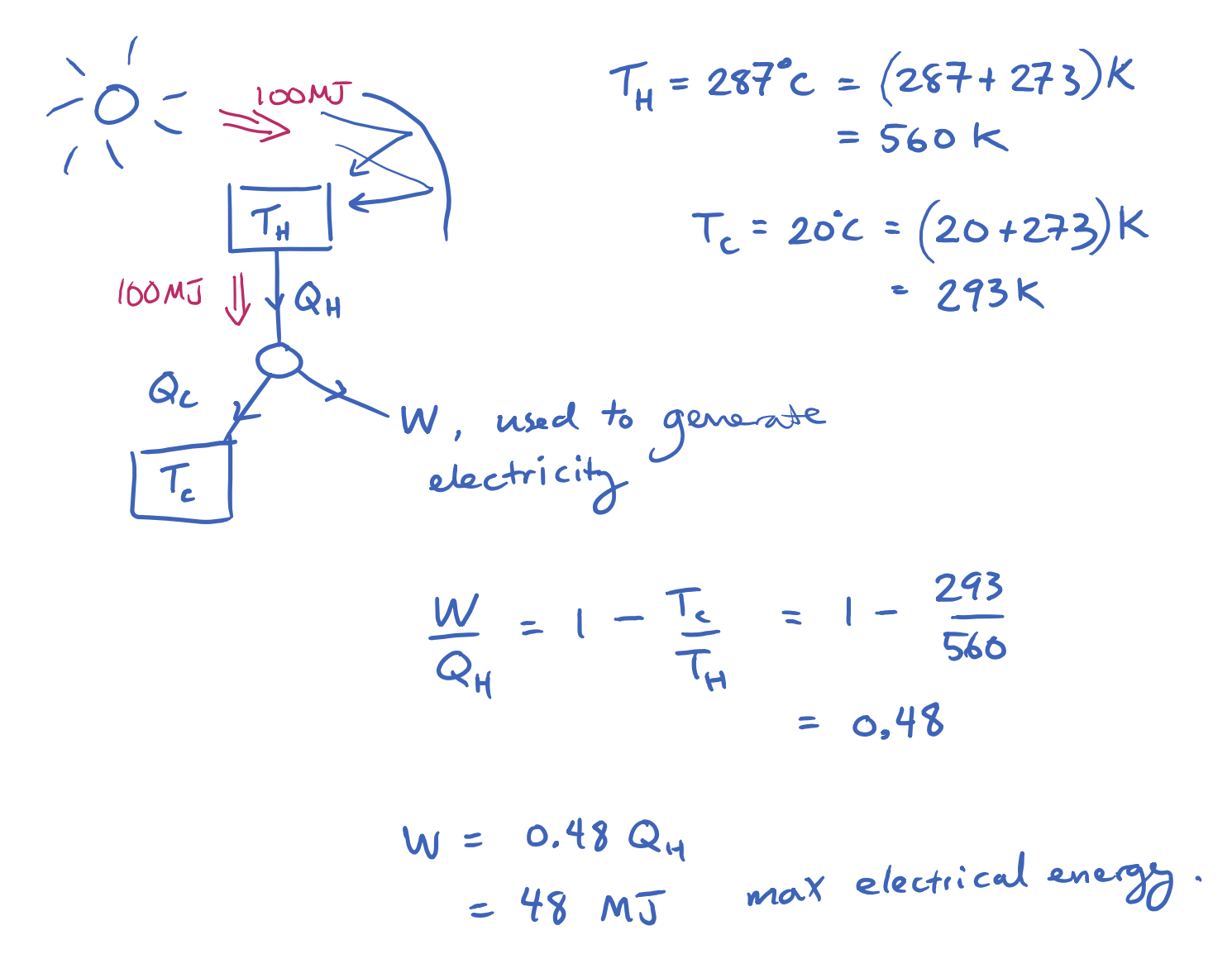
The Andasol power plant in Spain uses solar-heated molten salt and a traditional heat engine to make electricity. Concentrated sunlight is used to heat the tank of molten salt. Heat flows from the molten salt into a heat engine which produces electricity. Assume the molten salt is kept at a steady, uniform temperature of 287 \(^\circ\)C throughout the day. What is the maximum amount of electrical energy that the Andasol power plant can obtain from 100 MJ of solar energy? Give your answer in megajoules.
(Assume the ambient air temperature in Spain is 20 \(^\circ\)C, and the efficiency of the heat engine is fundamentally limited by the second law of thermodynamics.)
- Heat capacity of chlorine molecule
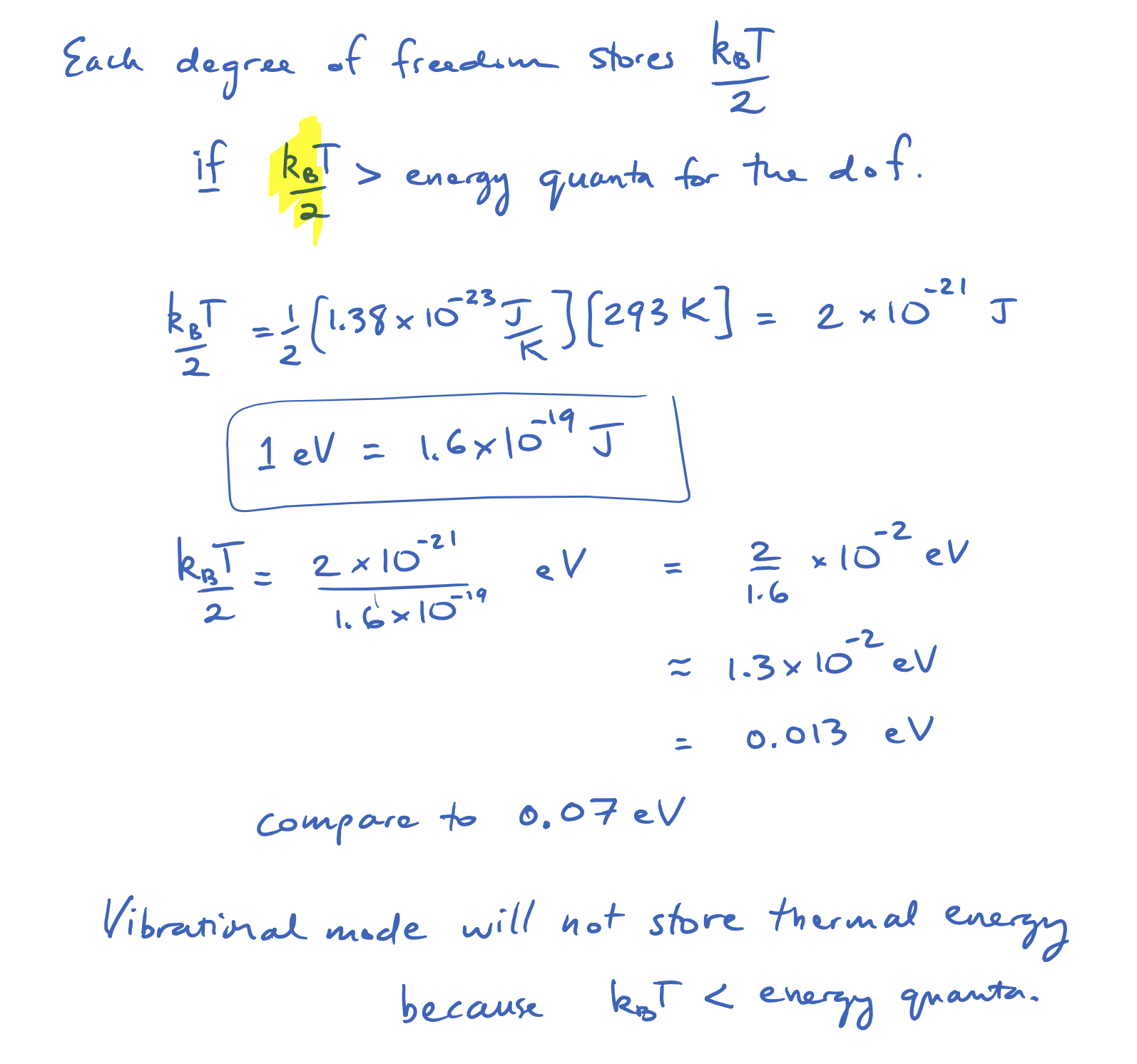
The quantum of vibrational energy for a Cl2 molecule is 0.07 eV (0.07 electron-volts).
(a) At room temperature (20 \(^{\circ}\)C), do you expect Cl2 to store any energy in this vibrational mode? Give quantitative reasoning to support your answer.
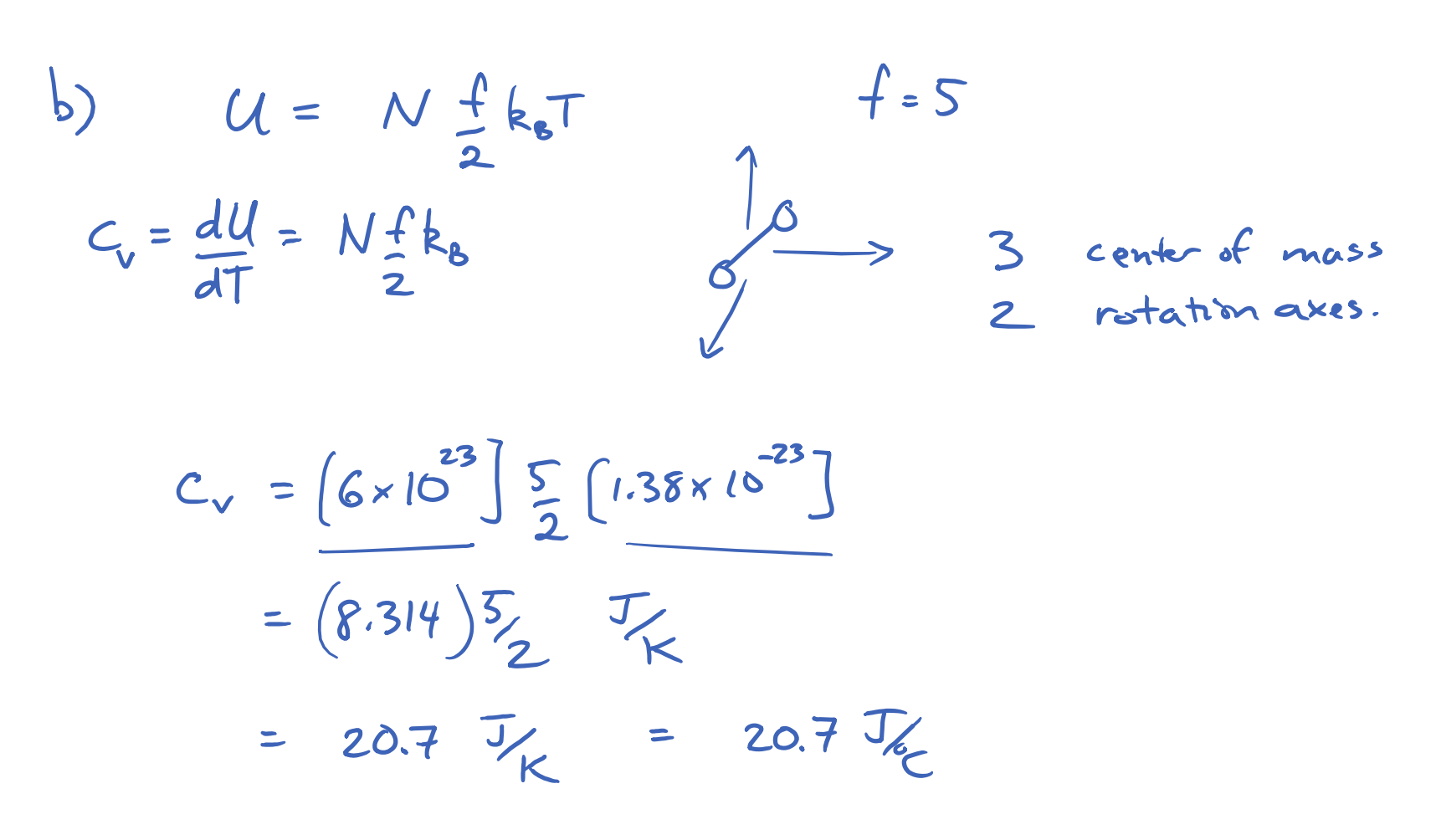
(b) Consider 1 mole of Cl2 molecules in gas phase held at constant volume and initial temperature 20 \(^{\circ}\)C. Estimate the heat capacity of this gas. Give you answer in units of J/\(^{\circ}\)C.
(a)
(b)
- Standing waves on a harp
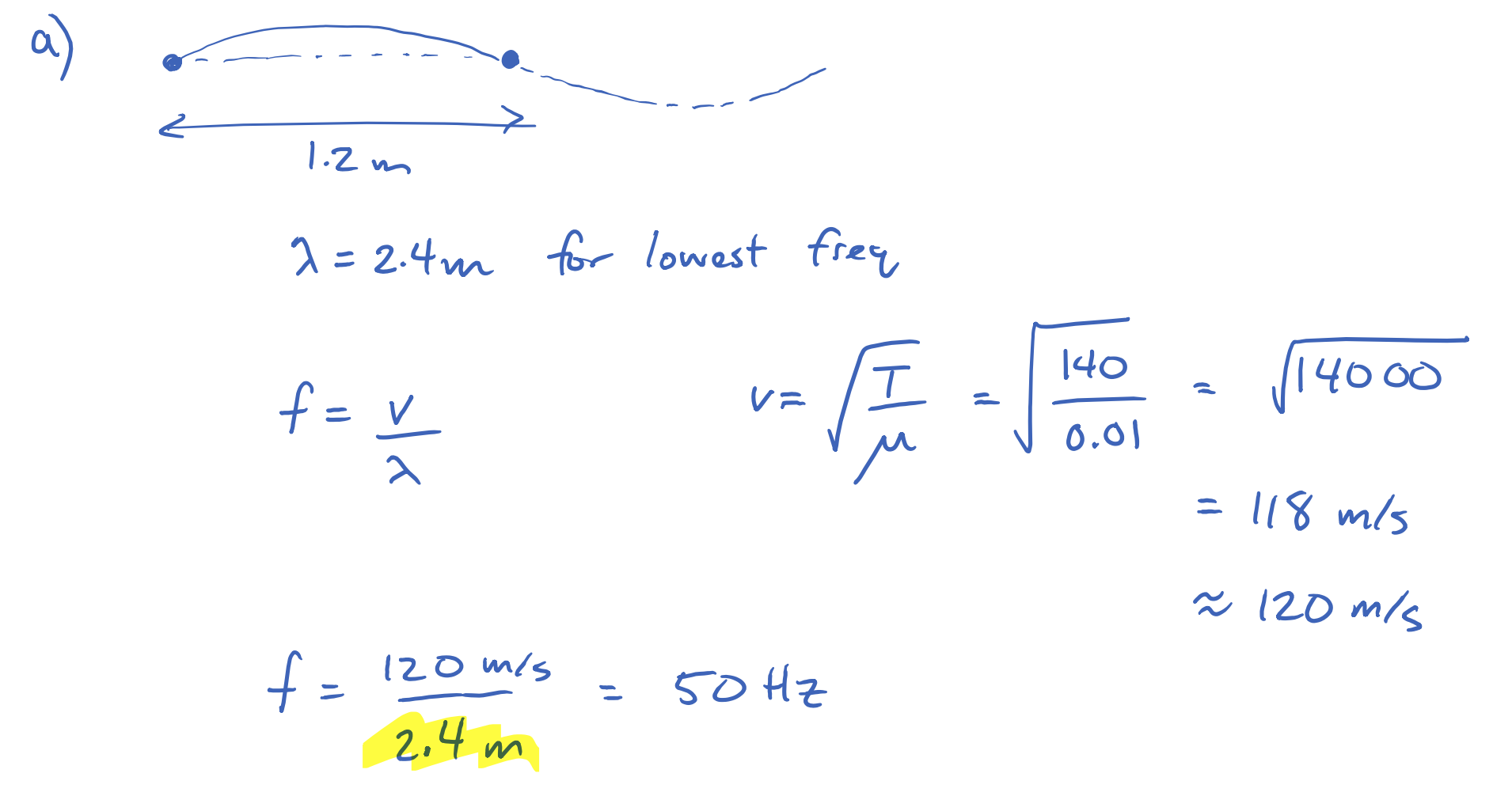
Consider the longest string on a harp. The string is clamped at two ends and has a suspended length of 1.2 meters. The tension of the string is 140 N. The mass per unit length of the string is 10 grams/meter.
(a) Calculate the lowest frequency with which this harp string could vibrate. Give a numerical answer in units of Hz.
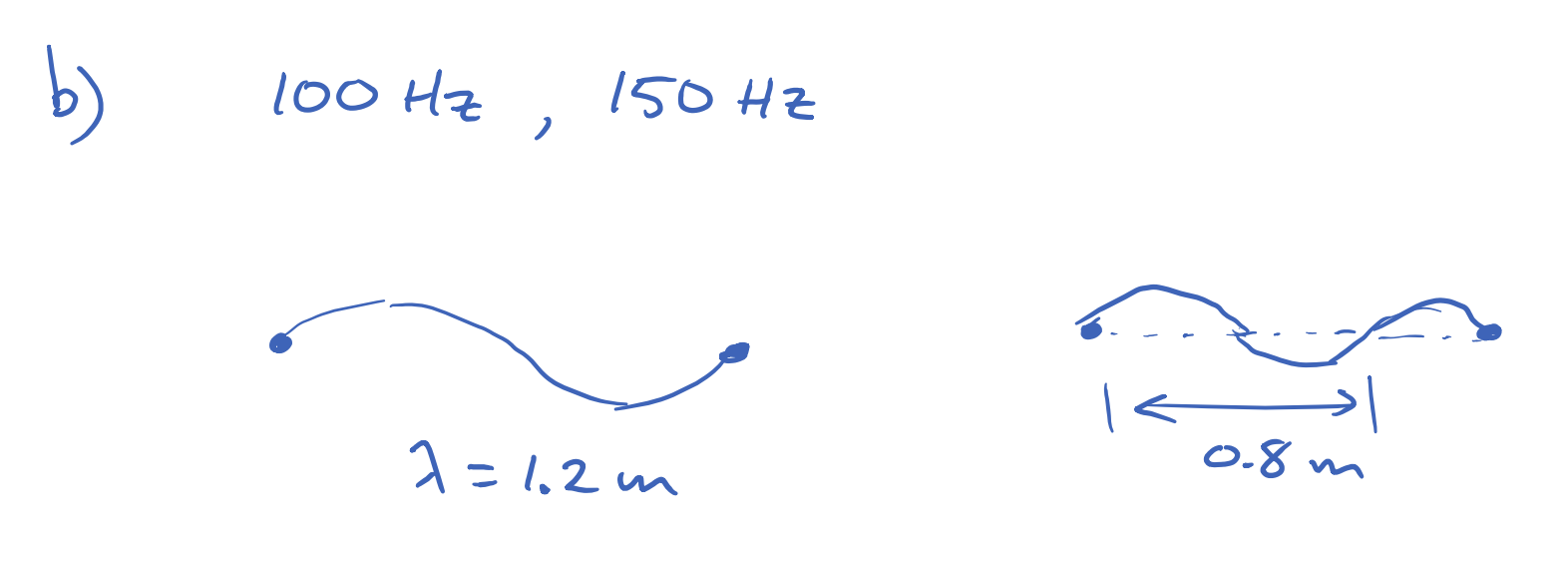
(b) List two higher frequencies that this string can vibrate.
(a)
(b)