Problem-Solving: Fall-2024
Tutorial 3 (Required): Due W3 D2
- Sphere in Cylindrical Coordinates Find the surface area of a sphere using cylindrical coordinates. Note: The fact that you can describe spheres nicely in cylindrical coordinates underlies the equal area cylindrical map projection that allows you to draw maps of the earth where everything has the correct area, even if the shapes seem distorted. If you want to plot something like population density, you need an area preserving map projection.
- Charge on a Spiral A charged spiral in the \(x,y\)-plane has 6 turns from the origin out to a maximum radius \(R\) , with \(\phi\) increasing proportionally to the distance from the center of the spiral. Charge is distributed on the spiral so that the charge density increases linearly as the radial distance from the center increases. At the center of the spiral the linear charge density is \(0~\frac{\textrm{C}}{\textrm{m}}\). At the end of the spiral, the linear charge density is \(13~\frac{\textrm{C}}{\textrm{m}}\). What is the total charge on the spiral?
- Current in a Wire The current density in a cylindrical wire of radius \(R\) is given by \(\vec{J}(\vec{r})=\alpha s^3\cos^2\phi\,\hat{z}\). Find the total current in the wire.
- Contours
Shown below is a contour plot of a scalar field, \(\mu(x,y)\). Assume that \(x\) and \(y\) are measured in meters and that \(\mu\) is measured in kilograms. Four points are indicated on the plot.
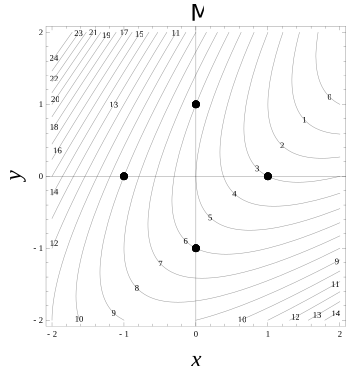
- Determine \(\frac{\partial\mu}{\partial x}\) and \(\frac{\partial\mu}{\partial y}\) at each of the four points.
- On a printout of the figure, draw a qualitatively accurate vector at each point corresponding to the gradient of \(\mu(x,y)\) using your answers to part a above. How did you choose a scale for your vectors? Describe how the direction of the gradient vector is related to the contours on the plot and what property of the contour map is related to the magnitude of the gradient vector.
- Evaluate the gradient of \(h(x,y)=(x+1)^2\left(\frac{x}{2}-\frac{y}{3}\right)^3\) at the point \((x,y)=(3,-2)\).