Problem-Solving: Fall-2024
Tutorial 2 (Required): Due W2 D2
- Tetrahedron
Using a dot product, find the angle between any two line segments that join the center of a regular tetrahedron to its vertices. Hint: Think of the vertices of the tetrahedron as sitting at the vertices of a cube (at coordinates (0,0,0), (1,1,0), (1,0,1) and (0,1,1)---you may need to build a model and play with it to see how this works!)
- Distance Formula in Curvilinear Coordinates
The distance \(\left\vert\vec r -\vec r\,{}'\right\vert\) between the point \(\vec r\) and the point \(\vec r'\) is a coordinate-independent, physical and geometric quantity. But, in practice, you will need to know how to express this quantity in different coordinate systems.
Find the distance \(\left\vert\vec r -\vec r\,{}'\right\vert\) between the point \(\vec r\) and the point \(\vec r'\) in rectangular coordinates.
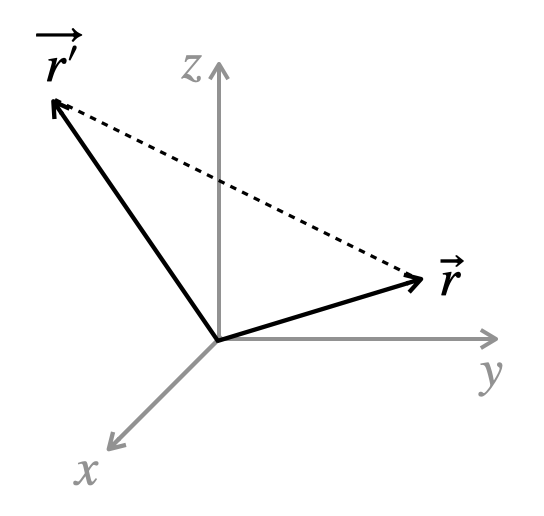
Show that this same distance written in cylindrical coordinates is: \begin{equation*} \left|\vec r -\vec r\,{}'\right| =\sqrt{s^2+s\,{}'^2-2ss\,{}'\cos(\phi-\phi\,{}') +(z-z\,{}')^2} \end{equation*}
Hint: You may want to use the textbook: GMM: Change of Coordinates
Show that this same distance written in spherical coordinates is: \begin{equation*} \left\vert\vec r -\vec r\,{}'\right\vert =\sqrt{r'^2+r\,{}^2-2rr\,{}' \left[\sin\theta\sin\theta\,{}'\cos(\phi-\phi\,{}') +\cos\theta\cos\theta\,{}'\right]} \end{equation*}
Hint: You may want to use the textbook: GMM: Change of Coordinates
- Now assume that \(\vec r\,{}'\) and \(\vec r\) are in the \(x\)-\(y\) plane. Simplify the previous two formulas.
- Linear Quadrupole (w/ series)
Consider a collection of three charges arranged in a line along the \(z\)-axis: charges \(+Q\) at \(z=\pm D\) and charge \(-2Q\) at \(z=0\).
Find the electrostatic potential at a point \(\vec{r}\) in the \(xy\)-plane at a distance \(s\) from the center of the quadrupole. The formula for the electrostatic potential \(V\) at a point \(\vec{r}\) due to a charge \(Q\) at the point \(\vec{r}'\) is given by: \[ V(\vec{r})=\frac{1}{4\pi\epsilon_0} \frac{Q}{\vert \vec{r}-\vec{r}'\vert} \]
Assume \(s\gg D\). Find the first two non-zero terms of a power series expansion to the electrostatic potential you found in the first part of this problem.
- A series of charges arranged in this way is called a linear quadrupole. Why?